
One Nation’s $3.8 Million Question: Is the Party Finally Breaking Through in Australia’s Cities?
By Michael Keating | Inside Canberra
CANBERRA, Sunday — Pauline Hanson’s One Nation is now less than $106,000 away from its latest fundraising target after the party’s “Fire the Liar” campaign reached $3,794,129 from 61,829 Australians as of Sunday morning.
The figure cements the campaign as one of the largest grassroots political fundraising efforts seen in modern Australian political history.
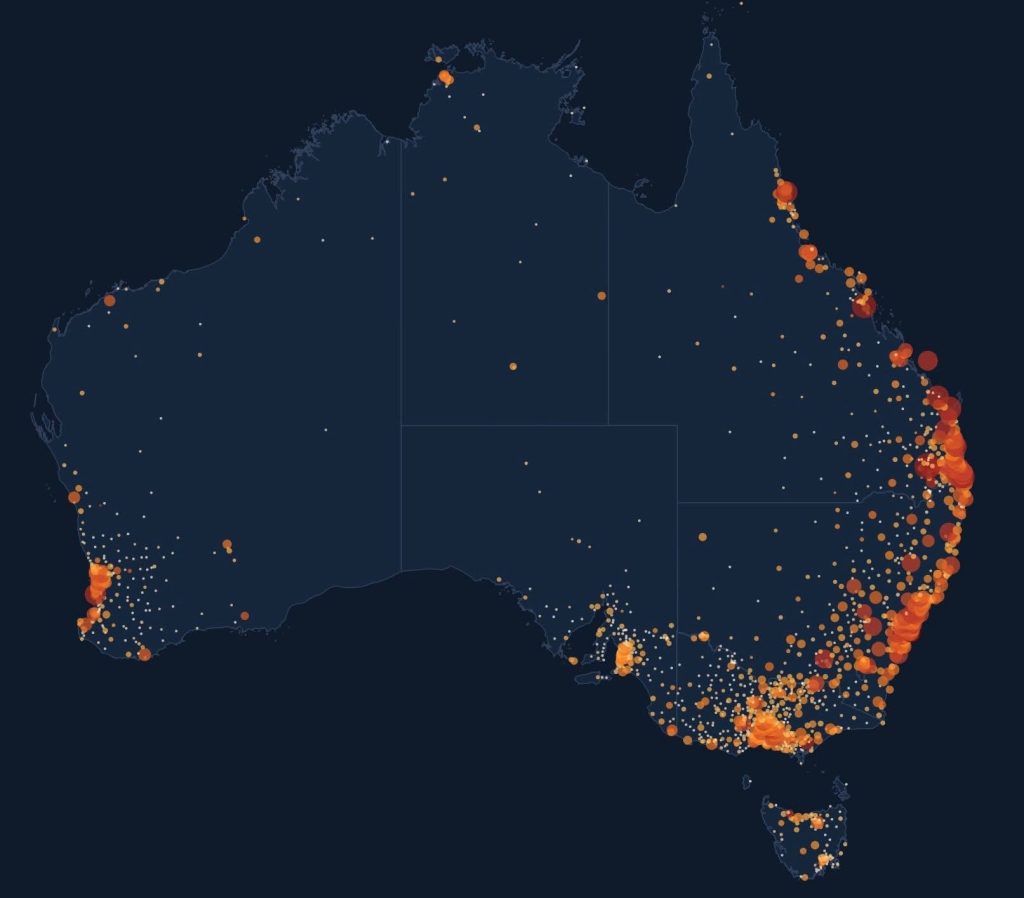
But while the fundraising total itself is remarkable, a recently released heat map showing the geographic spread of donations may reveal something even more significant: the campaign appears to be attracting substantial support from Australia’s major metropolitan centres, not just the regional communities traditionally associated with One Nation.
For decades, One Nation’s political strength has been linked primarily to regional and rural Australia. Political commentators have frequently questioned whether the party could ever successfully translate that support into a broader metropolitan movement capable of influencing elections in Australia’s largest cities.
The heat map suggests that transformation may already be underway.
The Cities Light Up
At first glance, the map confirms what many observers would expect.
Regional Queensland, regional New South Wales and parts of Western Australia remain clearly visible areas of support. Significant clusters appear throughout areas where One Nation has historically polled strongly.
However, the most striking feature of the map is not the regional activity.
It is the concentration of donations around Australia’s major population centres.
Sydney’s metropolitan region is densely illuminated, particularly throughout western and outer suburban areas. Melbourne’s suburban growth corridors display extensive activity. South-East Queensland forms one of the most intense concentrations on the map, while Perth, Adelaide and Hobart also show significant donor participation.
The visual evidence suggests this campaign is not being sustained solely by regional Australia.
Instead, it appears to be attracting support from metropolitan and outer-suburban Australians in numbers substantial enough to dominate large portions of the map.
If correct, that would represent one of the most important political developments for One Nation since its founding in 1997.
Beyond the Traditional Base
Australia’s electoral battleground has increasingly shifted away from traditional rural seats and towards outer metropolitan electorates where concerns about housing affordability, cost-of-living pressures, migration, infrastructure and government services are often felt most acutely.
Those same issues have featured prominently in One Nation’s messaging.
The challenge for One Nation has never been generating support in regional Australia. The challenge has been converting that support into a genuinely national movement capable of competing for voters in Australia’s major urban centres.
A fundraising campaign supported by more than 61,000 Australians suggests the party may be making progress on that front.
Whether that translates into votes at future elections remains an open question, but the scale and apparent geographic spread of donations is difficult to ignore.
What the Heat Map Doesn’t Tell Us
While the map provides a fascinating snapshot, it also highlights the limitations of the information currently available.
The visualisation demonstrates broad participation across the country but does not reveal:
- How many donations came from each city;
- Which electorates generated the strongest support;
- Whether support is concentrated in outer suburbs or inner-city areas;
- Average donation sizes by region;
- The proportion of metropolitan versus regional contributors; or
- Whether donors are existing One Nation supporters or first-time contributors.
The heat map provides an important starting point, but it does not provide the detailed data needed to properly assess the campaign’s political significance.
A Case for Greater Transparency
This is where One Nation has an opportunity.
If the party wishes to demonstrate that its support extends well beyond traditional regional strongholds, it should consider publishing an anonymised breakdown of donations by city, postcode or electorate.
No personal information would need to be disclosed.
Providing aggregated regional data would allow journalists, researchers and voters to independently assess where the campaign’s momentum is strongest and determine whether the apparent metropolitan participation is as significant as the heat map suggests.
Such transparency would also provide valuable insight into broader political trends at a time when many Australians appear increasingly dissatisfied with the major parties.
A Political Signal Worth Watching
Regardless of political affiliation, the scale of the campaign is noteworthy.
What began as a response to Labor fundraising efforts has evolved into one of the most successful grassroots political fundraising campaigns Australia has seen in recent years.
Yet the most interesting story may not be the money itself.
It may be where that money is coming from.
The heat map is not definitive proof that One Nation has broken through in metropolitan Australia. Australia’s major cities contain the largest populations, so naturally they would be expected to generate significant donor activity.
However, the concentration visible throughout Sydney, Melbourne, Brisbane, Perth and Adelaide is substantial enough to warrant closer examination.
If future data confirms that a significant proportion of donations are originating from metropolitan and outer-suburban Australia, it could signal that voter dissatisfaction with the political establishment is becoming increasingly national rather than predominantly regional in character.
The fundraising success is already remarkable.
The geographic distribution of that support may ultimately prove even more significant.
For now, the heat map raises an important question.
One Nation has shown it can raise millions of dollars.
The next question is whether those millions reveal a party whose support base is expanding far beyond the regions and into the cities where Australia’s political future will increasingly be decided.