
Hilton defends CSIRO cuts while setting out sovereign science agenda
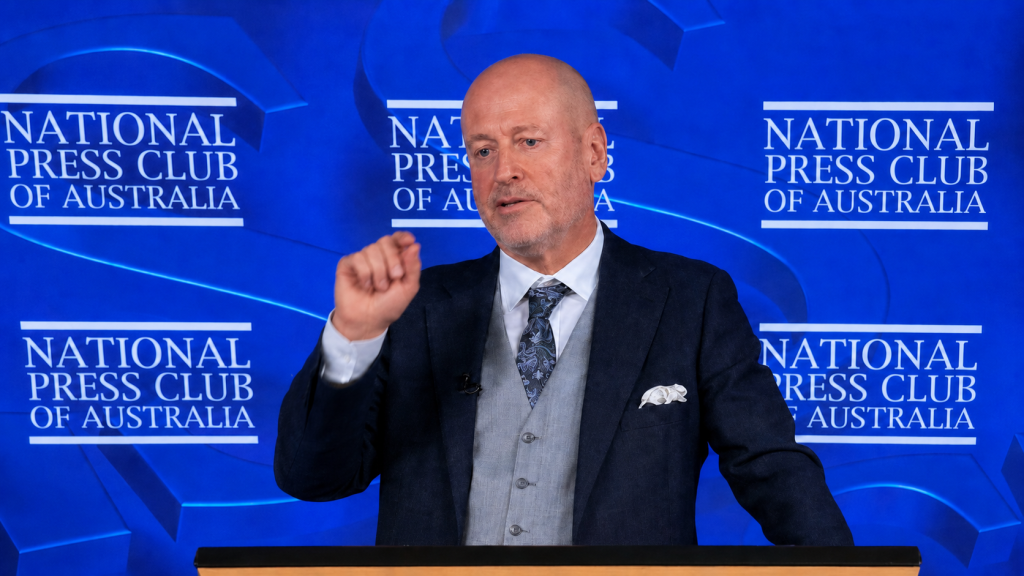
The CSIRO chief says a sharper research focus, domestic technological capability and greater public accountability will be essential as Australia confronts artificial intelligence, change and a more precarious global order.
CSIRO Chief Executive Dr Doug Hilton has defended the national science agency’s contentious restructuring as an unavoidable response to decades of deteriorating infrastructure and increasingly diffuse research priorities, while outlining a broader doctrine of “sovereign science” for Australia’s next decade.
Addressing the National Press Club in Canberra on Wednesday, Dr Hilton argued that Australia could no longer assume unfettered access to technologies, data and international supply chains developed elsewhere.
Instead, he called for greater domestic capability across artificial intelligence, biosecurity, clean energy, critical minerals and climate science — underpinned by Australian data being used for Australian benefit.
In a more uncertain international environment, Dr Hilton said supply chains had become less dependable and technological advantage was increasingly being wielded as an instrument of national power. Australia was therefore being compelled to reconsider its sovereign scientific capability, biosecurity preparedness and place within the global research system.
The speech, delivered during CSIRO’s centenary year, combined an expansive account of Australia’s scientific possibilities with a robust defence of the difficult institutional decisions made under his leadership.
A sharper mission for CSIRO
Dr Hilton said the agency’s challenge was not a shortage of worthwhile scientific ideas, but the necessity of deciding which research CSIRO was uniquely positioned to conduct at sufficient scale.
He pointed to the agency’s role in identifying the Hendra virus, developing cotton varieties that underpin Australia’s industry and producing technology foundational to modern Wi-Fi as examples of research that united audacity, collaboration and national impact.
The question confronting CSIRO now, he argued, was whether those attributes could be applied with comparable discipline to Australia’s contemporary economic and strategic problems.
After reviewing the agency’s research portfolio, CSIRO elected to leave some fields and narrow its work in others rather than distribute increasingly constrained resources across too many programs.
“The greatest risk for CSIRO was not making the wrong decision; it was making no decision,” Dr Hilton said.
That philosophy has had substantial human consequences. CSIRO confirmed after the May Budget that previously announced changes involving an estimated reduction of between 300 and 350 full-time-equivalent positions would proceed, notwithstanding an additional $387.4 million over the forward estimates.
Dr Hilton acknowledged the effect upon researchers who had devoted much of their professional lives to particular scientific disciplines, describing the consequences for staff, their teams and their families as profound.
His argument, however, was that institutional leadership could not preserve every existing activity merely because it was worthwhile. CSIRO was required to determine where its research could assist an entire industry, benefit communities at scale or alter the national trajectory, rather than produce only incremental gains.
Decades of deterioration
The restructuring was presented not merely as a savings exercise, but as an attempt to arrest a sustainability problem Dr Hilton said had accumulated over approximately 50 years.
CSIRO operates 45 sites, down from 106 during the 1990s, and receives an annual Commonwealth appropriation of about $1 billion. Yet more than 80 per cent of its approximately 800 buildings had reached their technical end of life by the end of 2025, according to Dr Hilton.
Ageing laboratories, an insufficient capital budget, outdated information technology and the rising cost of conducting research had progressively reduced the organisation’s room to manoeuvre.
The Albanese Government provided an additional $233 million through the Mid-Year Economic and Fiscal Outlook before committing a further $387.4 million in the Budget. Dr Hilton said the funding placed CSIRO on a pathway to renewal for the first time in decades.
It will support repairs, scientific equipment, cyber protection and modernised technology, as well as the approximately $1 billion refurbishment of the Australian Centre for Disease Preparedness in Geelong.
The high-containment facility has assumed renewed significance following the arrival of H5N1 avian influenza in Australia.
The Budget also provides the centre with ongoing annual funding from 2030–31. Broader organisational certainty, however, remains concentrated within the forward estimates, leaving future governments with responsibility for sustaining the renewal program.
Climate restructuring tests the boundary between science and policy
The most searching questions following the address concerned reductions within CSIRO’s Environment Research Unit, including positions associated with climate modelling.
The final changes involve 92 positions, including scientists connected with the Australian Community Climate and Earth System Simulator, or ACCESS. Critics have warned that Australia could lose specialist expertise that would be difficult to reconstruct and which informs agriculture, disaster preparedness, insurance, infrastructure planning and Pacific climate adaptation.
Science & Technology Australia has argued that Australia carries a national and regional responsibility to preserve this capability. Researchers associated with ACCESS have similarly warned that reductions could weaken the only global climate model developed in the Southern Hemisphere.
Those concerns deserve consideration, but the restructuring should not automatically be characterised as an abandonment of climate science.
A dedicated organisational structure is not synonymous with scientific capability. There is also a legitimate distinction between undertaking rigorous research into climatic conditions and maintaining an institutional area whose work may become entwined with contested political prescriptions.
CSIRO is a research institution, not a policy advocacy body. Climate observation, modelling and the assessment of environmental change properly belong within its scientific remit. Decisions about emissions targets, energy systems, taxation and the distribution of economic costs ultimately belong to elected governments.
On that interpretation, reducing or reorganising a dedicated climate area may represent an attempt to restore clearer institutional boundaries rather than diminish the importance of the underlying science.
Dr Hilton said more than two-thirds of CSIRO’s research contributed in some way to addressing climate change. Relevant work would continue across environment, energy, minerals, agriculture and biosecurity, with greater emphasis placed upon adaptation, resilience and practical technological responses.
CSIRO’s account of its revised research direction identifies climate adaptation and resilience among its principal priorities and confirms that the Environment Research Unit will remain one of the agency’s two largest research units.
This approach could strengthen CSIRO if it produces research that is empirical, applicable and accessible across political divisions. A national science agency maintains public confidence most effectively when it supplies governments and communities with reliable evidence without appearing to prescribe a particular political program.
The remaining question is therefore not whether CSIRO retains a particular organisational label, but whether Australia preserves the scientific capabilities it genuinely requires.
CSIRO has said responsibility for the continued stewardship of ACCESS has been transferred into sustained national research infrastructure through ACCESS-NRI. Nevertheless, specialist modelling expertise can be lost even when formal responsibility is dispersed across several institutions, and Dr Hilton stopped short of guaranteeing that CSIRO itself would maintain precisely the same modelling output with fewer personnel.
The restructuring should consequently be judged by its results: whether it preserves indispensable scientific capability, removes unnecessary duplication and directs more resources towards research with demonstrable national value.
Australian AI rather than an unwinnable race
Artificial intelligence formed the other principal component of Dr Hilton’s sovereign science argument.
He described AI as possessing enormous potential to lift productivity and accelerate discovery, but warned that Australia should not become wholly dependent upon foreign technology, models and data infrastructure.
Australia, he argued, needed a course that built domestic capability and resilience, harnessed Australian data for Australian benefit and protected human creativity and social cohesion.
Dr Hilton also rejected the proposition that CSIRO was simply closing its Data61 digital research capability.
Data61 and CSIRO’s manufacturing research operations are being brought together within a new Technology Research Unit. Dr Hilton said the objective was to embed AI and computational expertise across research into agriculture, energy, biosecurity and critical minerals, rather than retain digital capability within a comparatively isolated institutional structure.
He conceded that Australia could not match the expenditure of American technology companies or China across the entire spectrum of large language models.
A more credible strategy would concentrate resources where Australia possessed distinctive datasets and scientific strengths. These could include specialised foundation models for geoscience, Earth observation, biodiversity and environmental monitoring, together with continued expertise in cybersecurity and cyber resilience.
Asked whether the Commonwealth should secure a national reserve of computing power for public researchers, Dr Hilton confirmed that the Government was actively considering Australia’s future supercomputing requirements and that CSIRO was contributing technical advice.
He also suggested Australia could deepen collaboration with countries facing similar technological dependencies, including Britain, Canada, Japan, South Korea and European nations.
Such partnerships would not amount to complete technological self-sufficiency. They could, however, reduce the risks of excessive dependence upon a small number of foreign technology companies and strengthen Australia’s bargaining position within international research networks.
Science asked to demonstrate its value
Dr Hilton’s address carried a message not only for government, but for universities and the wider research establishment.
Australia’s total research and development expenditure has fallen to about 1.7 per cent of gross domestic product, compared with an OECD average of approximately 2.7 per cent. The Government’s Ambitious Australia review has called for substantial changes to research incentives, commercialisation, institutional collaboration and private-sector investment.
While supporting an ambition to lift Australia’s research expenditure, Dr Hilton argued that the scientific community first needed to demonstrate that it was making the best possible use of its existing resources.
He nominated three principles: focus, collaboration and accountability.
Institutions should be clearer about their comparative strengths, funding should encourage collaboration rather than institutional competition, and researchers should explain the public value of their work in terms accessible to communities beyond the scientific establishment.
Dr Hilton warned against scientific institutions becoming self-referential or treating sceptical sections of the public with disdain. Researchers, he argued, could not expect continuing public investment without engaging seriously with the people whose taxes sustained their work.
He also placed responsibility upon politicians and the media, criticising the selective use of evidence in public debate and warning that persistent polarisation could further erode confidence in scientific institutions.
The argument is particularly relevant to climate research. Public confidence is unlikely to be strengthened by blurring the distinction between empirical findings and political prescriptions. It is more likely to endure when scientific institutions explain what the evidence establishes, acknowledge uncertainty and leave elected governments accountable for policy choices.
A doctrine born of constraint
The central tension in Dr Hilton’s address was unmistakable.
CSIRO is being asked to strengthen Australia’s sovereign capability at precisely the moment it is reducing staff, consolidating research units and withdrawing from fields its leadership considers insufficiently distinctive or influential.
Dr Hilton’s case is that concentration, modern infrastructure and strategic collaboration will ultimately produce greater national capacity than attempting to preserve every existing program.
His critics contend that expertise lost through redundancies may prove difficult to reconstruct when it is next required. That concern is especially acute in highly specialised areas where capability depends upon small teams developed over decades rather than equipment or funding alone.
His defence, however, is stronger than a simple appeal to financial necessity.
CSIRO is a research institution, not an advocacy organisation. Concentrating its resources upon empirical science, technological development and practical national problems may reinforce both its institutional purpose and its public legitimacy.
The distinction is consequential. Preserving a program because it conducts necessary research is one thing; preserving a bureaucratic structure because its subject has acquired political prominence is another. A national science agency must be capable of evaluating the difference.
The latest funding injection will not settle that argument.
What Dr Hilton has now provided is a clearer account of the institutional philosophy behind the decisions: CSIRO will seek to do fewer things at greater scale, deploy digital capability across its scientific portfolio and measure research against its contribution to industry, communities and national objectives.
It is an approach born of financial and institutional constraint, but also one that seeks to redefine Australian scientific sovereignty in more practical terms.
As Australia confronts technological dependency, geopolitical instability and a comparatively weak record of converting research into economic complexity, the consequences of those choices will extend well beyond CSIRO.