
Job mobility falls to 7.2 per cent as Australia’s post-pandemic churn recedes
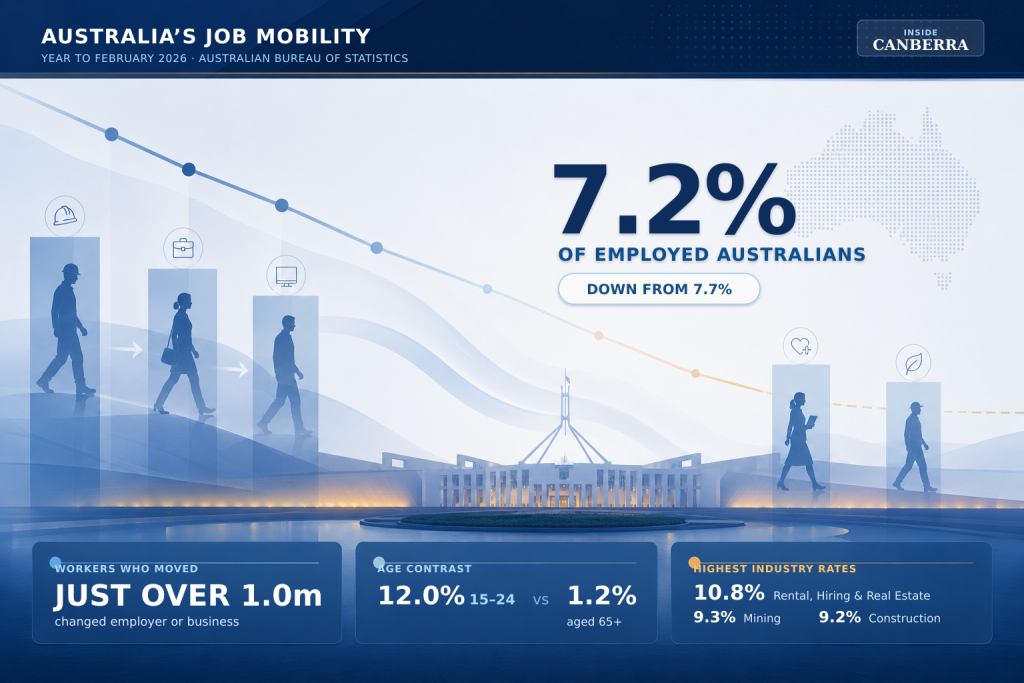
Australia’s workforce has become less mobile, with the proportion of employed people changing employer or business falling to 7.2 per cent in the year to February 2026.
New figures from the Australian Bureau of Statistics show just over one million employed Australians changed jobs during the period, compared with a mobility rate of 7.7 per cent in the preceding year.
The measure captures people who changed employer or business during the year as a proportion of all those employed in February 2026. It therefore provides a broader indication of labour-market movement than redundancies, resignations or monthly employment figures considered separately.
“Just over 1.0 million employed people, or 7.2 per cent, changed their employer or business,” ABS head of labour statistics Robert Long said.
The latest decline extends a long-term reduction in job mobility dating back to the 1970s, notwithstanding pronounced periods of movement around major economic disruptions. The ABS said notable peaks had occurred near the recessions of the early 1980s and early 1990s, as well as during the COVID-19 pandemic.
The result suggests the exceptional labour-market churn that accompanied Australia’s post-pandemic reopening has continued to dissipate.
A strong workforce with fewer opportunities to move
The mobility figures do not, in isolation, indicate that the labour market has become weak.
Australia added 76,300 employed people in June, taking total seasonally adjusted employment to 14.82 million, while the unemployment rate remained at 4.4 per cent, according to the ABS’s latest Labour Force figures.
However, the number of available positions has retreated considerably from its post-pandemic peak. There were 329,500 job vacancies in May 2026, down 2.1 per cent over the quarter and 30.3 per cent below the record level reached in May 2022.
Taken together, the figures depict a labour market that continues to generate employment but offers workers fewer opportunities to move than during the acute labour shortages of 2021 and 2022.
Lower mobility can reflect several conditions, including fewer suitable vacancies, greater caution among employees, improved satisfaction with existing roles or a reduced financial incentive to accept the risks associated with changing employers. The ABS data do not establish which of these factors predominates.
Mobility falls more sharply among women
The decline was considerably larger among women.
Women’s job mobility fell by 0.8 percentage points to 7.1 per cent in the year to February. The male rate declined by a more modest 0.2 percentage points to 7.4 per cent.
Employees remained substantially more likely to move than self-employed Australians, recording respective mobility rates of 8 per cent and 3 per cent.
Age also produced a pronounced disparity. Australians aged between 15 and 24 recorded a mobility rate of 12 per cent, making them the group most likely to change jobs. At the other end of the workforce, only 1.2 per cent of employed people aged 65 and over changed employer or business.
The difference partly reflects the established nature of later-career employment, while younger workers are more likely to be entering occupations, acquiring qualifications and searching for roles better suited to their skills or circumstances.
Property, mining and construction record highest rates
Rental, Hiring and Real Estate Services recorded the country’s highest industry mobility rate at 10.8 per cent.
Mining followed at 9.3 per cent, narrowly ahead of Construction at 9.2 per cent. Accommodation and Food Services recorded a rate of 8.8 per cent, while Wholesale Trade stood at 8.4 per cent.
At the other end of the table, Agriculture, Forestry and Fishing had the lowest rate at 4.5 per cent, followed by Education and Training at 4.6 per cent.
Public Administration and Safety recorded a mobility rate of 6.6 per cent, below the national result. That figure is a national industry measure rather than an ACT-specific reading, but it provides a useful benchmark for Canberra’s large public-sector workforce.
The figures also reveal whether people remained within their existing industries when they moved.
Among those leaving jobs in Arts and Recreation Services, 86 per cent entered a different industry. The corresponding proportion was 83 per cent in Electricity, Gas, Water and Waste Services.
Construction displayed the greatest degree of industry retention: 74 per cent of construction workers who changed jobs remained within the sector. Health Care and Social Assistance followed, with 65 per cent remaining in the industry.
Consequences for wages and productivity
Job mobility matters beyond the number of people changing employers.
Reserve Bank research has found that workers who move generally receive larger wage increases than those who remain with the same employer. Greater mobility can also encourage businesses to raise salaries to retain existing staff when competition for labour is intense.
Movement between employers can improve the allocation of labour by allowing people to find positions better suited to their skills and by transferring workers towards more productive enterprises.
Lower mobility is not necessarily undesirable. Longer tenure can produce greater stability, institutional knowledge and professional development, while some job changes are involuntary. Nevertheless, a prolonged reduction can weaken competitive pressure on employers and impede the movement of labour towards expanding industries.
Annual growth in the Wage Price Index moderated to 3.3 per cent in the March quarter of 2026, compared with 3.4 per cent a year earlier. The different reference periods mean the two sets of figures should not be treated as demonstrating causation, although both are consistent with an economy moving beyond the unusually tight conditions of the immediate post-pandemic period.
For policymakers, the emerging question is whether lower mobility principally represents welcome stability or diminishing economic dynamism.
The distinction will matter for wage growth, productivity and the capacity of the Australian workforce to adjust as demand shifts between industries. The latest figures suggest that, despite continued employment growth, Australian workers are becoming less inclined—or less able—to seek their next opportunity elsewhere.