
Chisholm pledges Labor support for coal as Asian demand endures
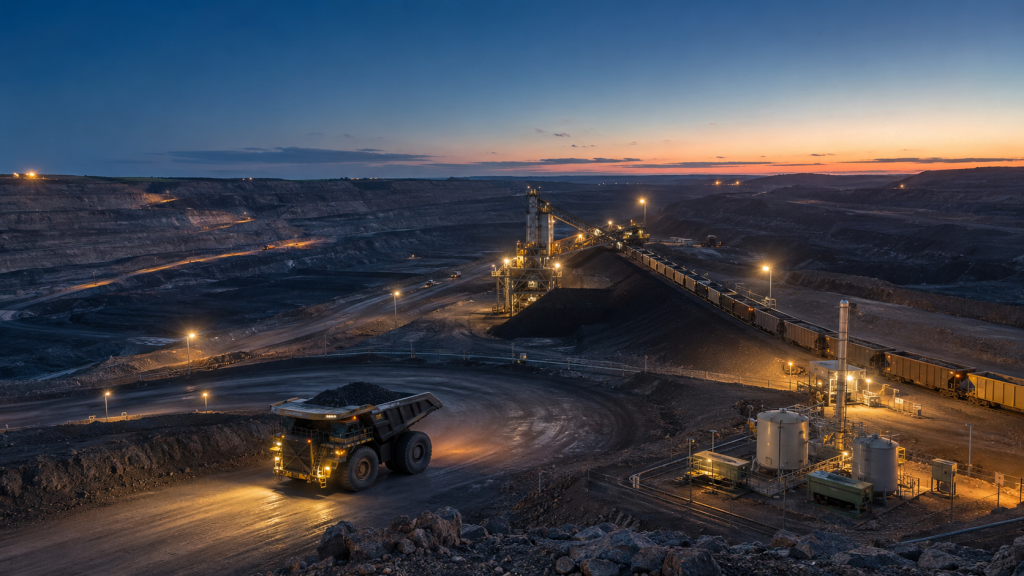
Assistant Resources Minister Anthony Chisholm says coal will remain integral to regional energy security and steelmaking, although government forecasts point to increasingly divergent trajectories for Australia’s thermal and metallurgical coal exports.
The Albanese Government has delivered one of its clearest recent assurances to Australia’s coal sector, with Assistant Minister for Resources Anthony Chisholm declaring that Labor stands behind the industry and expects coal to remain consequential to regional energy systems for decades.
Addressing the Coal Australia Industry Dinner in Brisbane on Thursday evening, Senator Chisholm sought to reconcile three increasingly interdependent policy imperatives: sustaining a major export industry, reducing emissions from mining operations and strengthening Australia’s resilience against disruption to international energy supply chains.
“The Albanese Government stands with our resources sector, including the coal industry,” he said.
The speech amounted to an explicit assurance to producers, workers and coal-dependent regional communities that the government does not regard the energy transition as synonymous with the immediate displacement of Australian coal.
Rather, Chisholm presented the sector as an enduring component of Australia’s economic and strategic architecture—particularly through Queensland’s pre-eminence in metallurgical coal, which remains essential to conventional steelmaking.
Peak Downs tragedy casts shadow over industry gathering
Before addressing the industry’s economic contribution, Chisholm paid tribute to the worker killed at the Peak Downs mine near Moranbah on 24 July.
Resources Safety and Health Queensland said the worker was a passenger in a light vehicle involved in a collision with a haul truck at approximately 4.38am. The light-vehicle driver was injured and taken to hospital, while the haul-truck driver was uninjured.
Investigations remain underway.
Chisholm also acknowledged the seriously injured worker and a first responder who suffered a medical episode while attending the scene, while commending the Moranbah community for gathering to observe a minute’s silence.
“I know that as an industry, we can do better,” he said, promising to follow the investigation and any steps required to prevent similar fatalities.
The remarks placed mine safety at the forefront of an address otherwise intended to celebrate the industry’s economic contribution and reassure it of continued federal support.
Coal framed as an economic and strategic asset
Chisholm traced Queensland’s coal industry from small-scale extraction around Ipswich in the 1840s to the development of the Bowen Basin, which transformed the state into one of the world’s principal metallurgical coal suppliers.
Queensland accounts for a substantial share of internationally traded metallurgical coal, providing the state with a position of particular importance in Asian steel supply chains.
Chisholm told the dinner that Australian coal exports were worth approximately $90 billion in 2024–25 and supported about 50,000 jobs.
The export figure in the prepared speech appears, however, to contain a financial-year discrepancy. The federal government’s June 2026 Resources and Energy Quarterly records 2024–25 thermal coal exports of approximately $32 billion and metallurgical coal exports of $39.3 billion—a combined nominal value of about $71.3 billion.
The figure of approximately $90 billion more closely corresponds with 2023–24, when the two categories generated a combined $91.4 billion.
The distinction does not diminish coal’s importance as an export industry, but it illustrates the extent to which earnings fluctuate with international commodity prices even when underlying volumes remain comparatively resilient.
Global record masks a more complicated outlook
Chisholm pointed to global coal demand reaching a record 8.845 billion tonnes in 2025 as evidence that international demand has not disappeared.
That figure accords with the International Energy Agency’s Coal 2025 analysis, although the agency’s medium-term outlook is more qualified. It expects total demand to plateau before easing towards the end of the decade, with continued expansion in India and South-East Asia offset by contractions in advanced economies and China’s gradually changing energy system.
For Australia, the outlook differs markedly between thermal coal used principally for electricity generation and metallurgical coal used in steelmaking.
The Resources and Energy Quarterly forecasts Australian metallurgical coal exports to rise from 150 million tonnes in 2025–26 to 163 million tonnes in 2028–29, before easing to 157 million tonnes by 2030–31. Growth in Indian and South-East Asian steel production is expected to support demand.
Thermal coal exports, by contrast, are forecast to decline gradually from 213 million tonnes in 2025–26 to 197 million tonnes by 2030–31 as major customers expand renewable generation and place greater emphasis on domestic energy security.
The forecasts suggest that coal will remain commercially significant throughout the decade, but not that every part of the industry faces the same trajectory.
Japan and India central to export strategy
Japan remains Australia’s largest thermal coal customer. Chisholm said Australia exported 73 million tonnes to Japan in 2024–25, worth approximately $14.1 billion and accounting for 36 per cent of Australian thermal coal exports.
While Japanese coal consumption is expected to decline over time, Chisholm argued that the country would continue to require both thermal and metallurgical coal for decades.
India presents a different proposition. Its expanding steel industry is expected to make it an increasingly important destination for Australian metallurgical coal, while the broader bilateral relationship is acquiring a stronger energy-security dimension.
Prime Minister Anthony Albanese and Indian Prime Minister Narendra Modi signed an Australia–India Joint Statement on Energy Security on 9 July.
The statement committed both countries to maintaining stable and reliable supplies of energy products, specifically including coal, diesel, natural gas and other liquid fuels. It simultaneously endorsed renewable energy, electrification and cooperation on low-carbon fuels.
Chisholm cast the agreement as evidence of continuing Indian demand and Australia’s determination to remain a reliable regional supplier.
Methane abatement enters the policy equation
The minister also acknowledged that continued government support would be accompanied by greater attention to the emissions intensity of coal production.
He praised work being undertaken on methane abatement and decarbonisation, referring to a roundtable with coal companies earlier in the week at which emerging technologies and industry initiatives were discussed.
Chisholm indicated that he wanted those efforts recognised in future government policy, opening a potentially important conversation over how emissions reductions at operating mines will be measured, credited and encouraged.
Methane is a particularly consequential issue for underground coal operations. The government’s resources-sector emissions plan identifies fugitive methane as the predominant source of fugitive emissions from coal mining, making abatement one of the few areas in which substantial operational emissions reductions may be possible without immediately curtailing production.
The policy challenge will be to distinguish demonstrable abatement from merely aspirational commitments while ensuring that regulatory settings do not discourage investment in technologies capable of delivering measurable reductions.
Diesel security elevated by Middle East disruption
Chisholm concluded by placing coal within a wider argument about sovereign capability and supply-chain resilience.
Mining accounts for about one-quarter of Australia’s diesel consumption, according to figures cited in the speech, with coal operations responsible for almost half the mining sector’s total diesel use.
The minister commended major operators for maintaining private fuel-supply and storage arrangements, which allow mines to continue operating without drawing disproportionately upon supplies required by surrounding communities.
He said the government would continue working to maintain diesel availability, with particular attention to smaller operators that lack the storage capacity and contractual arrangements of the multinational producers.
The emphasis reflects a wider recalibration of energy policy as instability in the Middle East exposes Australia’s dependence on imported liquid fuels and vulnerable maritime supply routes.
Chisholm’s message was therefore broader than a conventional defence of coal. It presented the industry as simultaneously an export earner, employer, steelmaking supplier and contributor to Australia’s sovereign resilience.
The speech did not repudiate the energy transition. Instead, it advanced the argument that the transition will be protracted, uneven and dependent upon existing resources while alternative technologies and industrial processes develop.
For the Albanese Government, the enduring political test will be whether it can sustain the confidence of coal-producing communities and international customers while meeting its emissions commitments. Chisholm has now made clear that, within that balancing exercise, the government sees Australian coal as retaining a substantial place.