
NACC Inspector Ends Two Investigations into Former Commissioner Paul Brereton After Resignation
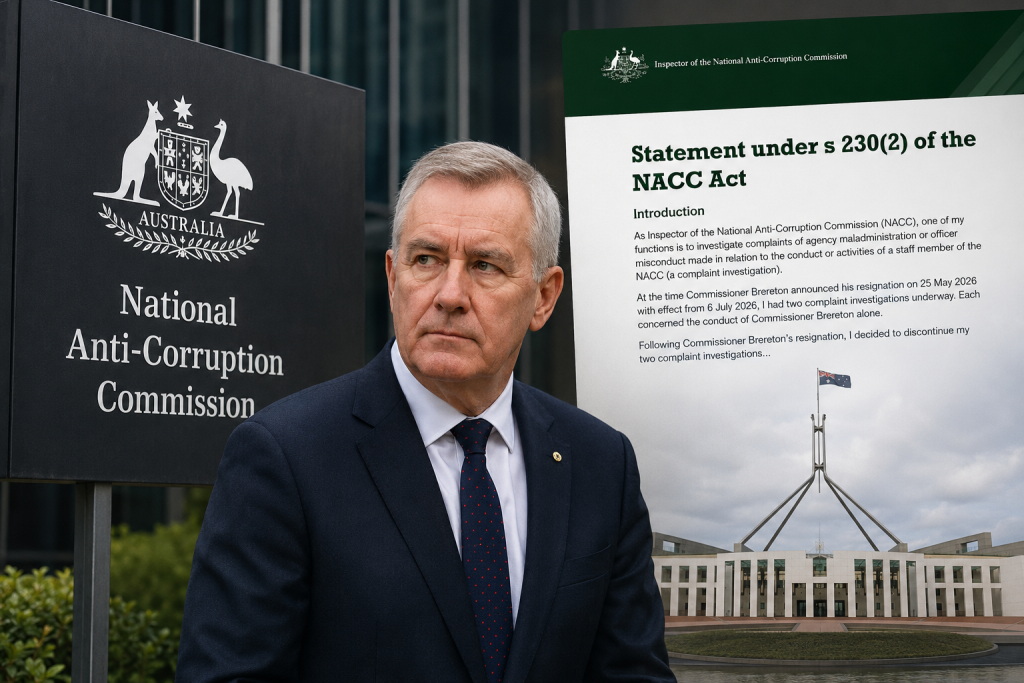
CANBERRA — The Inspector of the National Anti-Corruption Commission (NACC) has revealed that two advanced investigations into the conduct of former Commissioner Paul Brereton were discontinued following his resignation, concluding that while concerns surrounding his personal conduct warranted investigation, there was little public interest in completing the inquiries once he had left office and systemic issues had been addressed.
The statement, released under section 230(2) of the National Anti-Corruption Commission Act, provides the most detailed public account to date of the matters that had been under examination before Brereton stepped down as Commissioner on 6 July 2026. It also sheds new light on internal governance concerns within Australia’s anti-corruption watchdog.
Two investigations already well advanced
Inspector Gail Furness SC disclosed that both investigations had progressed to the stage where draft reports had been completed and provided to lawyers representing both the Commission and Commissioner Brereton for submissions before his resignation intervened.
Rather than indicating the allegations lacked substance, the Inspector makes clear that the investigations were substantially complete but had not yet reached a final determination.
The decision to discontinue them was based on statutory discretion and the assessment that the matters related solely to Brereton personally rather than broader corruption within the Commission.
Defence conflict-of-interest investigation
The first investigation centred on one of the most controversial issues to confront the NACC since its establishment — Commissioner Brereton’s continuing advisory relationship with the Inspector-General of the Australian Defence Force (IGADF) while simultaneously serving as Australia’s Anti-Corruption Commissioner.
The inquiry examined whether Brereton had properly managed actual or perceived conflicts arising from:
- his continuing commission as a Major General in the Army Reserve;
- honorary military appointments;
- ongoing voluntary advice to the IGADF concerning implementation of the Afghanistan Inquiry;
- and whether his statutory declarations of interests adequately disclosed those arrangements.
The Inspector recounts that then Attorney-General Mark Dreyfus had specifically warned Brereton before his appointment in 2023 that any continuing association with Defence would need to be “actively managed or, ideally, avoided.”
Brereton subsequently declared an “affiliation” with the IGADF in multiple declarations of interests, but in late 2025 Attorney-General Michelle Rowland questioned whether those declarations sufficiently explained the true extent of his ongoing advisory role.
Other NACC leaders were unaware
Perhaps the most striking revelation in the statement is that the NACC’s Chief Executive Officer and the Commission’s three Deputy Commissioners were unaware of Brereton’s continuing work with the IGADF until media enquiries in September 2025 brought the matter into the open.
That finding prompted the Inspector to examine whether broader governance failures existed within the Commission.
During the investigation, the Inspector also sought records relating to all 98 Defence-related referrals assessed by the NACC between July 2023 and October 2025, although that analysis remained incomplete when the investigation was discontinued.
Why the investigation stopped
The Inspector identifies several reasons for ending the inquiry after Brereton resigned.
First, much of the relevant factual material was already publicly known.
Second, the central legal dispute — whether Brereton’s declarations satisfied obligations under the Public Governance, Performance and Accountability Act — no longer required resolution once he ceased holding office.
Third, the conduct under examination related solely to Brereton rather than other Commission officers.
Most importantly, the Inspector concluded that governance reforms implemented by the NACC had addressed any systemic weaknesses uncovered during the investigation.
New disclosure regime introduced
Among the reforms highlighted is a new internal conflicts-of-interest process introduced on 19 June 2026.
Under the revised arrangements:
- statutory office holders must provide fuller declarations describing both the nature and extent of any interests;
- declarations are shared among all statutory office holders;
- office holders meet to scrutinise one another’s disclosures;
- concerns regarding potential conflicts are openly discussed rather than remaining confidential.
The Inspector concluded these reforms would deliver “more scrutiny, transparency and accountability” while reducing secrecy surrounding conflict management inside the Commission.
Second investigation remains largely confidential
The second investigation remains far more mysterious.
According to the statement, it arose from a complaint received in December 2025 concerning two separate NACC operations.
One allegation related to a single occasion involving Commissioner Brereton.
The Inspector reveals that:
- Brereton’s own response to the allegation prompted the formal investigation;
- the CEO and Deputy Commissioners had previously been unaware of the incident;
- lawyers for Brereton challenged the Inspector’s authority to investigate and publish findings;
- individuals connected with the matter expressed concerns for their own and their families’ safety if details became public.
Because of those safety concerns and the operational sensitivity of the events, the Inspector concluded that any public report would necessarily be heavily redacted and therefore of limited value.
Again, the Inspector found no broader systemic failures requiring institutional reform.
Significant public expenditure
The statement also reveals that considerable taxpayer funding had already been devoted to both investigations.
Completing the draft reports would have required substantial additional legal expenditure because parts of both investigations remained contested.
The Inspector ultimately determined that further spending could not be justified once Brereton had resigned and institutional reforms had already been implemented.
Questions likely to remain
Although the Inspector’s decision brings both investigations to an end, the statement leaves several important questions unanswered.
Because neither investigation reached final findings, there has been no determination on whether Brereton breached conflict-of-interest obligations or whether the allegations in the second investigation were substantiated.
Instead, the Inspector has effectively concluded that the public interest now lies in ensuring the NACC’s governance systems are stronger, rather than continuing costly investigations into the conduct of a Commissioner who no longer occupies the office.
For an institution established to reinforce public confidence in government integrity, the episode illustrates both the complexity of maintaining confidence in independent watchdogs and the importance of robust governance mechanisms applying even to those charged with overseeing integrity themselves.