
Dire Straits: Experts Warn Taiwan and South China Sea Tensions Could Reshape Australia’s Strategic Future
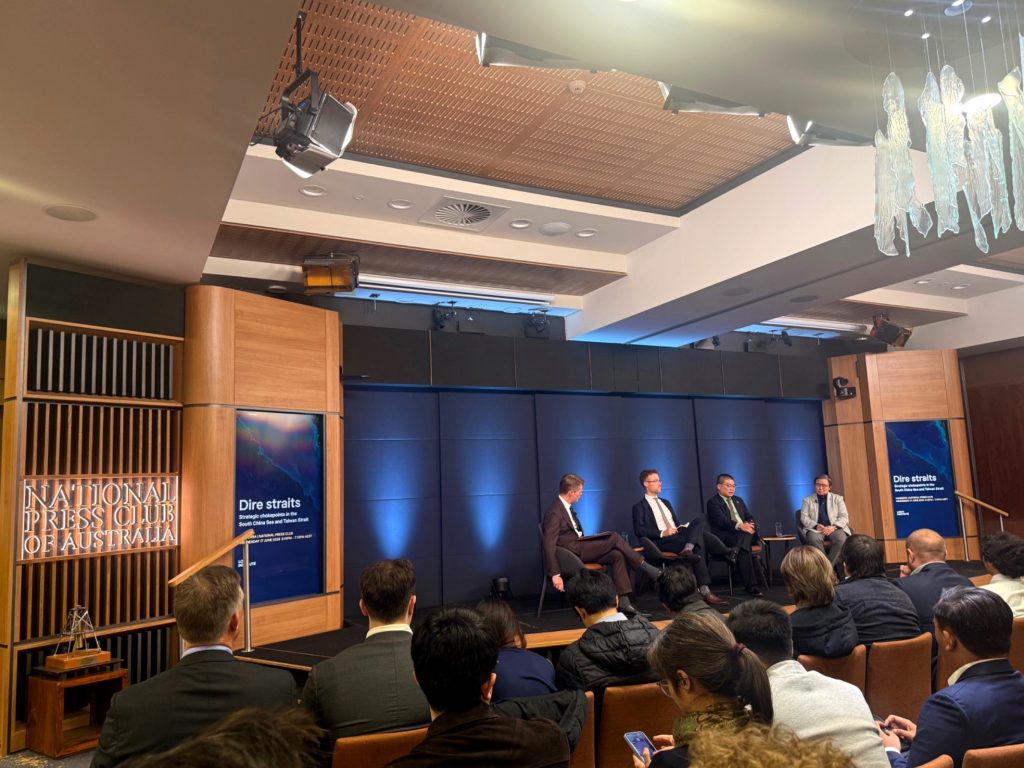
Canberra, ACT — A panel of leading regional security experts has warned that escalating tensions in the Taiwan Strait and South China Sea could have far-reaching consequences for Australia and Southeast Asia, highlighting vulnerabilities in critical maritime trade routes and raising questions about regional preparedness.
Speaking at a packed event hosted by the Lowy Institute at the National Press Club in Canberra on Wednesday evening, the discussion focused on “Dire Straits: Strategic Chokepoints in the South China Sea and Taiwan Strait.”
The panel featured Dr Hunter Marston, Director of the Southeast Asia Program at the Lowy Institute, Dr Ian Chong of the National University of Singapore, and Lena Alexandra, Head of International Relations at Indonesia’s Centre for Strategic and International Studies (CSIS).
The discussion came amid heightened international concern over maritime security following recent instability in the Middle East and ongoing tensions across the Taiwan Strait.
Maritime chokepoints under scrutiny
A central theme of the discussion was the vulnerability of global trade routes and energy supplies.
While the Strait of Hormuz has traditionally attracted attention as one of the world’s most significant maritime chokepoints, panellists argued that Southeast Asia’s waterways could face similar pressures during any future regional conflict.
Dr Marston noted that Southeast Asia remains heavily dependent on energy imports passing through vulnerable sea lanes, while Dr Chong warned that any conflict involving Taiwan would have consequences far beyond the immediate theatre.
“There will be no escape from the effects by any actor in the region,” he argued, describing maritime security challenges as interconnected across the Indo-Pacific.
Indonesia’s growing concerns
Lena Alexandra provided a particularly candid assessment of Indonesia’s concerns.
She warned that Indonesia’s vast archipelagic waters and strategic sea lanes could become vulnerable during a regional crisis and acknowledged that Jakarta continues to face significant challenges in monitoring and defending its maritime approaches.
Particular concern was expressed about the possibility of conflict spilling into Southeast Asian waters if tensions around Taiwan were to escalate.
Alexandra also highlighted the enormous human dimension of any Taiwan contingency, noting that hundreds of thousands of Indonesian citizens currently live and work in Taiwan.
She suggested that regional governments are only beginning to seriously examine evacuation planning and crisis-response scenarios.
AUKUS remains a regional talking point
The discussion also turned to AUKUS and Australia’s planned acquisition of nuclear-powered submarines.
While acknowledging that initial concerns surrounding AUKUS have eased since its announcement, Alexandra said questions remain within parts of Southeast Asia about how Australia would balance its alliance commitments with regional stability should a Taiwan crisis emerge.
Dr Chong observed that many Southeast Asian nations continue to see value in a sustained American presence in the region but also remain wary of actions that could unintentionally increase tensions.
The challenge, he suggested, is finding the right balance between deterrence and reassurance.
Taiwan remains the key flashpoint
Perhaps the most sobering discussion centred on Taiwan itself.
The panellists broadly agreed that Taiwan remains the most significant potential flashpoint in the Indo-Pacific.
Dr Chong noted that while many people across the region prefer not to contemplate a conflict scenario, the economic and strategic consequences would be impossible to ignore.
The Philippines, because of its proximity to Taiwan and alliance obligations with the United States, was identified as particularly exposed. Indonesia and other Southeast Asian nations would also face major challenges, including potential disruptions to trade, migration and regional security.
Why it matters for Australia
For Australia, the conversation underscored a reality increasingly recognised by policymakers: events in the Taiwan Strait and South China Sea are not distant disputes but developments with direct implications for Australia’s economy, energy security and strategic environment.
The panel offered no easy answers. However, the message was clear: while policymakers debate the future of the Indo-Pacific, the strategic significance of the region’s maritime chokepoints is growing, and the consequences of miscalculation could extend far beyond Asia’s shores.