
‘Surely the Governor-General should have asked’: Paul Kelly revisits Morrison’s secret ministries
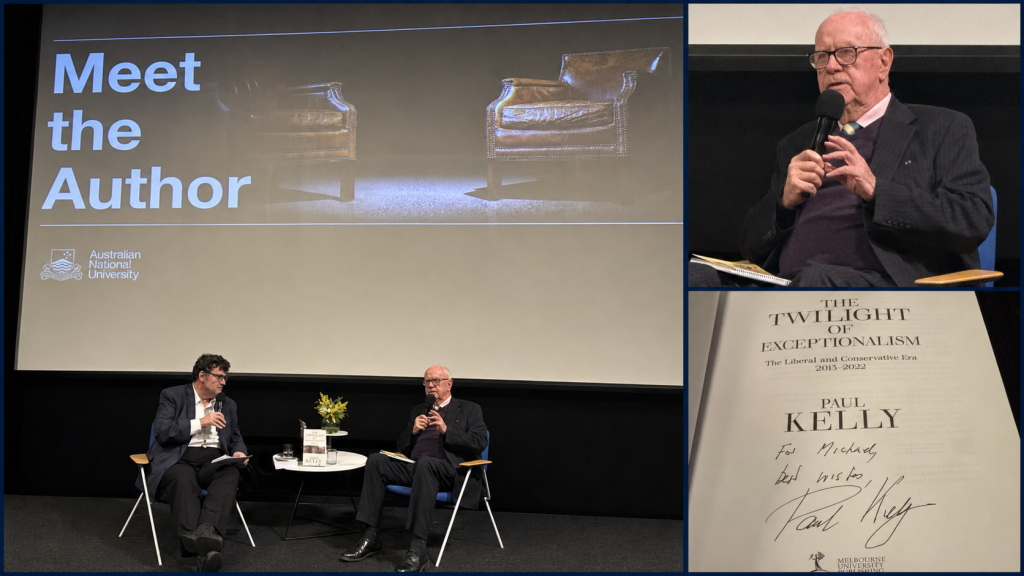
In remarks at The Australian National University, Paul Kelly questioned former governor-general David Hurley’s handling of Scott Morrison’s appointment to multiple ministries and delivered a series of candid judgements on Malcolm Turnbull, Tony Abbott, Bill Shorten and Anthony Albanese.
Veteran political journalist Paul Kelly has questioned why then governor-general David Hurley did not establish whether senior ministers had been informed before signing instruments appointing Scott Morrison to administer their departments.
Speaking at The Australian National University on Monday evening, Kelly said he remained “very, very suspicious” of the vice-regal handling of Morrison’s appointment to multiple ministries during the COVID-19 pandemic.
Kelly’s remarks came during an extended conversation with historian Professor Frank Bongiorno about his new book, The Twilight of Exceptionalism: The Liberal and Conservative Era 2013–22. Inside Canberra was present for the full discussion.
The event produced a succession of unusually candid observations extending beyond the book’s general thesis, including Kelly’s account of Morrison living with then treasurer Josh Frydenberg at The Lodge without revealing that he had also been appointed to administer Treasury; Malcolm Turnbull’s explanation of his own political decision-making; Tony Abbott’s private assessment of Greg Hunt; and Bill Shorten’s retrospective judgement of Labor’s 2019 platform.
Kelly questions Hurley’s handling of Morrison appointments
Asked about Morrison’s accumulation of ministerial responsibilities, Kelly described the arrangements as extraordinary and unjustified, but said they also exposed a failure of the institutions surrounding the prime minister.
“When it comes to the Governor-General, I’m very, very suspicious of the role of the Governor-General here in terms of signing these minutes,” Kelly said.
He argued that Hurley should have asked Morrison a direct question before signing the instruments.
“Surely the Governor-General should have asked Morrison, ‘Does the minister know that you’re being sworn into his portfolio?’” Kelly said.
Kelly then set out how he believed the exchange should have proceeded if Morrison acknowledged that the relevant minister had not been told.
“If Morrison had answered the question and said, ‘I haven’t bothered to tell him yet, Excellency,’ then the Governor-General would have said, ‘Well, in that case, Prime Minister, I won’t sign the minute until you speak to the minister.’”
Kelly contrasted Hurley’s approach with that of Sir Paul Hasluck, who served as governor-general from 1969 to 1974. Kelly observed Hasluck’s methods at close quarters while working in the Department of the Prime Minister and Cabinet’s Parliamentary and Government Division early in his career.
“I assert with no doubt whatsoever that that is the question Hasluck would have asked,” Kelly said. “And that is how Hasluck would have behaved as governor-general.”
The criticism concerns the degree of scrutiny applied to the prime minister’s advice, rather than the legal validity of the appointments themselves.
The Solicitor-General advised in 2022 that Morrison had been validly appointed and that the governor-general had no discretion to refuse the prime minister’s advice. In a contemporaneous statement, Hurley’s office said he had acted in accordance with the principle of responsible government, was not responsible for informing the ministry or public, and had “no reason to believe that appointments would not be communicated”.
Kelly’s argument was that the exceptional character of the arrangements should nonetheless have prompted a vice-regal question before the instruments were executed.
He also said Morrison had not received the firm departmental advice that should ordinarily have accompanied such an unprecedented proposal.
“It’s very clear Morrison did not get proper advice from Prime Minister and Cabinet being told not to do this,” Kelly said, describing the episode as “a breakdown in the system”.
‘Hey, mate, I’m also the Treasurer’
Kelly offered a striking illustration of the secrecy surrounding the appointments by pointing to the relationship between Morrison and Frydenberg.
Frydenberg was both treasurer and deputy Liberal leader when Morrison was appointed to administer the Treasury in May 2021.
“Josh Frydenberg, the Treasurer and Deputy Leader, at one stage lived in The Lodge with Morrison for a fortnight — actually lived together for a fortnight,” Kelly said.
“And Morrison never told Josh, ‘Hey, mate, I’m also the Treasurer.’ So this is fairly extraordinary stuff.”
Kelly suggested Morrison’s actions arose partly from his response to the enormous pressures generated by the pandemic and Chinese economic coercion.
Morrison, he said, had personalised the health, economic and strategic crises and developed a sense of personal political responsibility for safeguarding the country. Kelly argued that this mentality contributed to his decision to assume additional portfolios without properly consulting the ministers already administering them.
That interpretation did not excuse the appointments. Kelly said they “should never have happened”, but regarded Morrison’s state of mind as central to understanding how an experienced prime minister arrived at such an extraordinary course.
Turnbull’s faith in the ‘rational position’
Kelly was similarly forthright in his assessment of Malcolm Turnbull, whom he described as an “optimistic technocrat” governing in an increasingly ideological political age.
He recounted Turnbull’s explanation of how he reached policy decisions while prime minister.
“Malcolm used to say to me all the time when he was prime minister, ‘Paul, if you ever want to know what position I’m going to take on a policy issue, just ask yourself: what is the rational position? Because that’s where I’ll be.’”
Kelly said the sentiment captured both Turnbull’s intellectual confidence and his political limitation.
“Well, this is terrific,” he said. “But this is not how politics works.”
Politics could not be reduced to identifying what a leader regarded as the rational answer and then expecting the electorate to endorse it, Kelly argued.
He said Turnbull entered Parliament relatively late after careers in law, business and investment, having spent much of his professional life as a “solo operator”. That experience had not prepared him for the collective, ideological and relational demands of political leadership.
“Malcolm Turnbull never had politics in his bones at all,” Kelly said, contrasting him with Bob Hawke, Paul Keating, Malcolm Fraser and John Howard.
Kelly was particularly critical of Turnbull’s repeated assertion that he was not an ordinary politician and possessed a breadth of experience exceeding that of colleagues who had spent their careers in public life.
“This was a very arrogant and patronising thing to say,” he said, arguing that it reflected a misreading of the skills required to succeed as prime minister.
Turnbull’s difficulties were not inevitable. Kelly revealed that former Labor national secretary George Wright believed Labor had been “terrified” Turnbull would call an early election after replacing Abbott in 2015.
Wright’s assessment, as recounted by Kelly, was that Turnbull would have won convincingly. Former Department of the Prime Minister and Cabinet secretary Martin Parkinson similarly believed a commanding early victory would have transformed both Turnbull’s authority and the course of his government.
Instead, Turnbull waited until 2016, when Shorten out-campaigned him during an eight-week double-dissolution campaign. The Coalition lost 14 seats and returned with a majority of one, leaving Turnbull exposed simultaneously to an emboldened Labor opposition and an increasingly assertive conservative wing.
Abbott’s private judgement of Greg Hunt
Kelly also disclosed Tony Abbott’s assessment of the most capable minister in his government.
“Tony Abbott says to me, ‘Greg Hunt was technically the most capable minister in my government,’” Kelly told the audience.
Kelly said Abbott’s judgement was informed by Hunt’s responsibility for implementing one of the government’s defining promises: repealing the carbon-pricing mechanism after the 2013 election.
The measure was not guaranteed passage through a difficult Senate, but Hunt succeeded while other elements of the Abbott government’s program remained obstructed.
Kelly said Hunt later performed strongly as health minister during COVID-19, forming an effective leadership group with Morrison and Frydenberg during the initial national response.
The observation formed part of Kelly’s broader argument that the Coalition governments of 2013 to 2022 lacked the ministerial depth of the Hawke, Keating and Howard governments. Hunt and Frydenberg were presented as notable exceptions in an era when relatively few ministers left an enduring policy legacy.
Shorten concedes the strategic error of 2019
Kelly also recounted a significant admission from Bill Shorten about Labor’s unexpected defeat at the 2019 election.
Labor entered that campaign proposing substantial tax increases to finance an expansive social-policy program. In retrospect, Shorten told Kelly that the revenue should instead have been returned through personal income-tax reductions.
“The universe doesn’t grant reruns,” Kelly quoted Shorten as saying. “But I’ve thought about the 2019 election.”
Shorten’s conclusion was that, rather than financing the spending priorities of his colleagues, Labor should have returned the revenue to taxpayers.
Kelly characterised the statement as an exceptionally rare concession from a political leader and a “gigantic” acknowledgement of strategic error.
The admission also sharpened Kelly’s assessment of Morrison. He maintained that neither Turnbull nor Peter Dutton would have won the 2019 election and that Morrison’s campaign delivered a victory most senior Liberals had considered unattainable.
Morrison ‘a motor mechanic as a politician’
Although unsparing about Morrison’s failings, Kelly rejected a simplistic account of his prime ministership.
He described Morrison as intelligent, ambitious and highly competent as a minister — a conservative grounded in faith, family and country, but not principally a cultural warrior.
“I call him in the book a motor mechanic as a politician — a fixer,” Kelly said. “He wanted to get things fixed. He wanted to get the car on the road running properly.”
Kelly credited Morrison with the 2019 election victory and a strong initial economic response to COVID-19. He nevertheless concluded that Morrison was poorly equipped for changes in political culture that placed a growing premium upon empathy and sensitivity, particularly during the controversies involving Brittany Higgins and Grace Tame.
He also accused Morrison of blaming others when events went wrong, cutting corners and being “very loose with the truth” on several occasions.
Yet Morrison alone could not explain the Coalition’s defeat or subsequent decline. Had he been the essential problem, Kelly argued, the Liberal Party would have recovered after his departure.
Albanese: ‘He’s not an excitement machine — but he delivers’
Kelly’s judgement of Anthony Albanese was no less pointed.
He said Albanese reconstructed Labor after its 2019 defeat by adopting a strategy of caution and refusing to allow the Coalition to make Labor itself the principal election issue.
The result was a prime minister who did not conform to conventional ideas of inspirational leadership but had proved remarkably effective.
“He’s not inspiring. He’s not a visionary. He’s not an excitement machine,” Kelly said. “But he delivers.”
Kelly described the Albanese government as disciplined, united and outwardly unexciting, but predicted that it could change Australia substantially if sustained across three terms.
He also anticipated a more assertive expression of Labor belief and greater policy audacity from Albanese, arguing that the disruption affecting the centre-right could provide Labor with an extended period in government.
A launch rich in political testimony
The ANU event was part of its Meet the Author series and featured Bongiorno in conversation with Kelly, with Professor Mark Kenny, Director of the ANU Australian Studies Institute, delivering the vote of thanks.
The Twilight of Exceptionalism completes Kelly’s trilogy on modern Australian politics, following The March of Patriotsand Triumph and Demise. The new volume examines the Coalition governments led by Abbott, Turnbull and Morrison between 2013 and 2022.
Much of the public debate surrounding the book has centred upon Kelly’s description of the Liberal Party’s current predicament as an existential crisis. His remarks in Canberra, however, went considerably further.
They revealed the private judgements, retrospective admissions and institutional questions that animate political history — and which are rarely captured in formal speeches or rehearsed media appearances.
For those in the room, the most consequential question was not whether the Liberal Party remained in crisis. It was Kelly’s more specific challenge to the machinery of government during one of the most constitutionally unusual episodes of the Morrison years: why did nobody in authority stop and ask whether the ministers themselves knew?