
Pauline Hanson’s ‘Fire the Liar’ Campaign Surges Past $3 Million: A New Benchmark in Australian Political Fundraising?
By Michael Keating | Inside Canberra
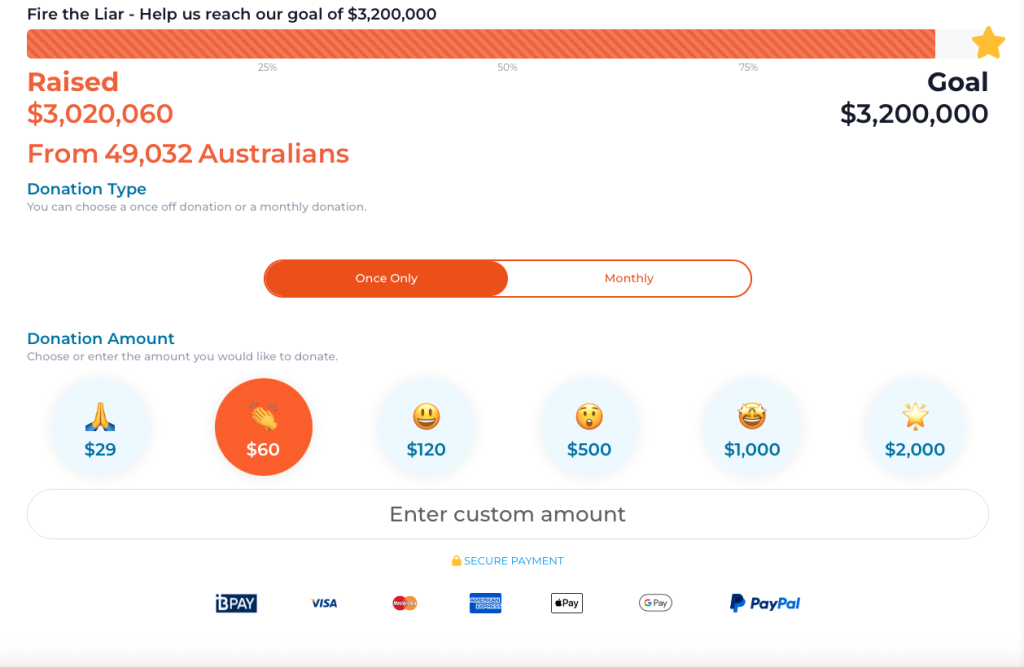
Pauline Hanson’s One Nation has launched what may become one of the most significant grassroots political fundraising campaigns in modern Australian history, with the party’s controversial “Fire the Liar” campaign now claiming more than $3 million raised from over 49,000 donors as of 12 June 2026.
According to the live fundraising tracker on the campaign website, the total had reached approximately $3.02 millionagainst a stated goal of $3.2 million, placing it within striking distance of its target.
The campaign was launched following a heated political exchange between Labor and One Nation and has quickly become one of the most talked-about fundraising drives in Australian politics.
From Political Attack to Fundraising Phenomenon
One Nation’s campaign centres on allegations that Prime Minister Anthony Albanese has failed to deliver on a range of commitments, including electricity prices, migration levels, tax policy and cost-of-living pressures. The fundraising page urges supporters to contribute towards advertising campaigns designed to challenge Labor in the lead-up to future elections.
What makes the campaign remarkable is not simply the amount raised, but the speed at which it accumulated.
Media reports indicate the campaign exceeded $1.5 million within its first 24 hours and later passed $2 million within approximately two days, attracting tens of thousands of donors.
The scale of the response has rattled political opponents, prompting public scepticism from Labor figures including Prime Minister Anthony Albanese and Labor President Wayne Swan.
The Audit Designed to Silence Critics
In response to questions about the legitimacy of the fundraising figures, One Nation commissioned an independent functional audit of the campaign’s donation system.
The audit concluded that the public fundraising total displayed on the website only included successfully processed and validated payments and excluded unpaid pledges, failed transactions, unreconciled BPAY payments and future recurring donations.
According to the audit, only completed and verified Stripe and PayPal transactions meeting specific validation criteria were included in the displayed fundraising total.
The report further concluded that the displayed figure represented actual funds received rather than pledged donations, a key distinction in political fundraising where headline figures can sometimes include future commitments.
While the audit was conducted when the campaign total was substantially lower than today’s figure, its findings were designed to address criticism that the public totals were inflated or misleading.
How Does It Compare?
Australian political parties traditionally rely heavily on major donors, fundraising dinners, corporate events and public funding tied to election results.
What makes the One Nation campaign unusual is its apparent reliance on a large volume of comparatively small donations.
At the current reported total of approximately $3 million from 49,032 donors, the average contribution sits at roughly $61 per donor.
That places the campaign closer to the small-donor fundraising model popularised internationally by figures such as:
- Bernie Sanders
- Barack Obama
- Donald Trump
In Australia, comparable examples are far rarer.
Major parties routinely raise millions annually, but individual issue-based campaigns generating millions of dollars from tens of thousands of donors in a matter of weeks are unusual by Australian standards.
The campaign has also benefited from an intensely polarising message that appears to have tapped into broader voter frustration over cost-of-living pressures, housing affordability and dissatisfaction with the major parties.
A Sign of Changing Politics?
Whether voters agree with One Nation’s message or not, the campaign highlights a broader trend in Australian politics.
Traditional party fundraising has often relied on major donors and corporate support. Increasingly, however, political movements are discovering the power of direct digital fundraising, allowing supporters to contribute immediately through social media, email campaigns and online advertising.
The campaign’s success also demonstrates that minor parties can now raise sums once thought achievable only by Labor or the Coalition.
With One Nation polling strongly in a number of regions and Labor publicly responding to the party’s growing influence, the fundraising effort has become more than just a source of campaign cash—it has become a political story in its own right.
The Bottom Line
If the reported figures continue to climb and withstand ongoing scrutiny, Pauline Hanson’s “Fire the Liar” campaign may ultimately be remembered as one of the most successful grassroots political fundraising drives ever seen in Australia.
At more than $3 million raised from nearly 50,000 donors, it has already entered territory rarely occupied by Australian minor parties.
Whether it translates into electoral success remains to be seen.
But as a fundraising exercise, it has already forced the political establishment to take notice.