
Operating Costs Surge for Australian Businesses as Overheads Replace Fuel as Biggest Pressure
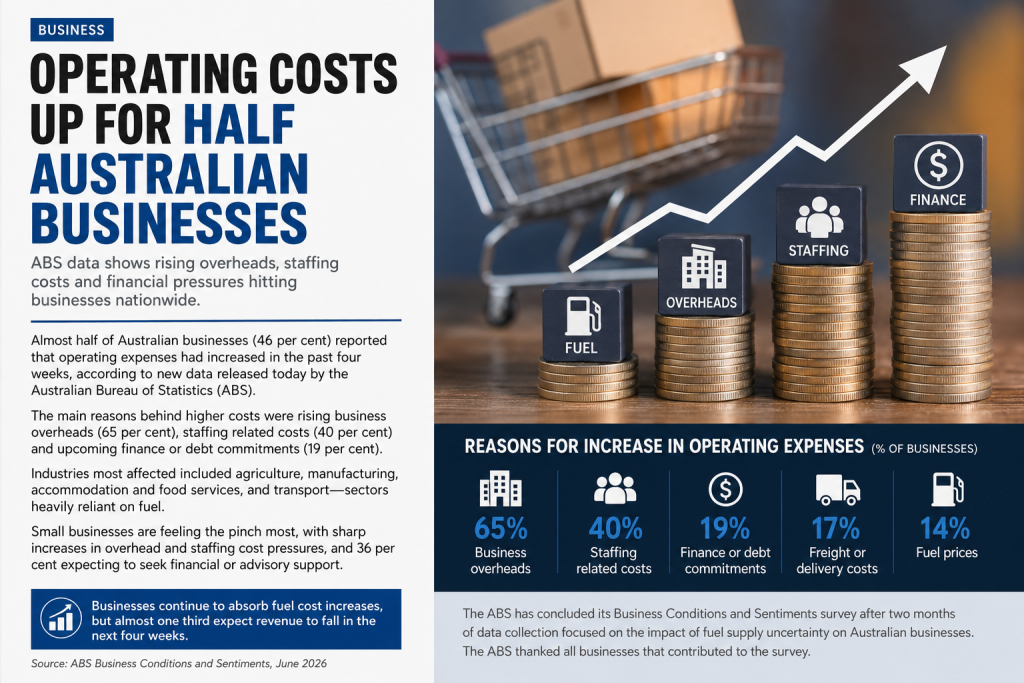
Nearly half of Australian businesses report rising operating expenses, with business overheads and staffing costs emerging as the dominant financial challenge despite easing fuel price pressures.
Australia’s businesses continue to face significant cost pressures, with new Australian Bureau of Statistics (ABS) data revealing that 46 per cent of businesses experienced higher operating expenses during the past four weeks. While concerns over fuel prices have eased from recent peaks, the latest figures suggest many businesses are now grappling with broader structural cost increases, particularly higher overheads, labour costs and finance commitments.
The findings come from the ABS’ Business Conditions and Sentiments Survey – June 2026, which surveyed approximately 2,700 businesses between 4 and 17 June.
Business overheads become the dominant cost pressure
Unlike previous surveys where fuel prices dominated concerns, the June data points to a shift in the underlying drivers of business costs.
Among businesses reporting higher operating expenses:
- 65 per cent cited rising business overheads.
- 40 per cent pointed to staffing-related costs.
- 19 per cent identified finance or debt commitments.
- Freight, delivery and input costs remained significant, although fuel price pressures eased compared with May.
ABS Head of Business Statistics Tom Lay said the data shows businesses are now facing a broader range of financial pressures.
“While the pressure from fuel prices had eased, there were more businesses that had noted higher costs.”
The shift suggests inflationary pressures are becoming embedded across everyday business operations rather than being concentrated in energy markets alone.
Fuel-dependent industries remain under pressure
Despite easing fuel costs overall, industries heavily reliant on transport continued to report the greatest financial strain.
The highest proportions of businesses experiencing increased operating expenses were:
- Agriculture, Forestry and Fishing – 72%
- Manufacturing – 55%
- Accommodation and Food Services – 55%
- Transport, Postal and Warehousing – 49%
These sectors remain particularly exposed to changes in supply chains, logistics costs and broader operating expenses.
Small businesses feeling the greatest strain
Perhaps the most significant finding is the growing pressure on Australia’s small business sector.
Compared with May, small businesses reported some of the sharpest increases in:
- Business overheads
- Staffing costs
- Financial stress
The survey found:
- 13 per cent of small businesses currently require financial or advisory assistance.
- 36 per cent expect to seek assistance within the next four weeks.
That level of anticipated support highlights continuing concern about cash flow and business sustainability, particularly as higher interest rates and operating costs continue to work through the economy.
Businesses still absorbing higher costs
Despite ongoing cost increases, many businesses have not yet fully passed those expenses onto consumers.
According to the ABS:
- 44 per cent absorbed increased costs themselves.
- 15 per cent increased prices.
- 6 per cent introduced fuel surcharges or levies.
The transport and logistics sector was the most likely to raise prices, reflecting its direct exposure to fuel and freight costs.
For consumers, this may indicate further price increases remain possible if businesses can no longer continue absorbing rising expenses.
Revenue outlook weakens
The survey also paints a cautious picture for business confidence.
Almost one-third of businesses reported declining revenue over the previous month, particularly across:
- Information Media and Telecommunications
- Wholesale Trade
- Accommodation and Food Services
Looking ahead, around one-third of businesses in these industries also expect revenue to fall further during the coming month.
The combination of rising costs and weakening revenue creates a challenging environment for profitability and investment.
A broader economic signal
Although inflation has moderated from its peak, the ABS data suggests many Australian businesses remain under considerable financial pressure.
The findings indicate that cost-of-living pressures affecting households are also being reflected inside businesses through higher wages, insurance premiums, rent, finance costs and other operating overheads.
For policymakers, the survey offers an important snapshot of how inflationary pressures are evolving beyond fuel prices and into the broader economy.
Notably, the ABS confirmed that this will be the final edition of the Business Conditions and Sentiments Survey, concluding a two-month data collection program established to monitor business responses during the period of fuel supply uncertainty.