
Labor’s Adelaide conference reveals the perils of governing by accumulation
The ALP’s sprawling draft platform combines social objectives with an ever-expanding role for government, unions and regulators. Its accompanying fringe program travels further still, exposing the risk that Labor’s governing discipline will be overwhelmed by the ambitions of its activist constituency.
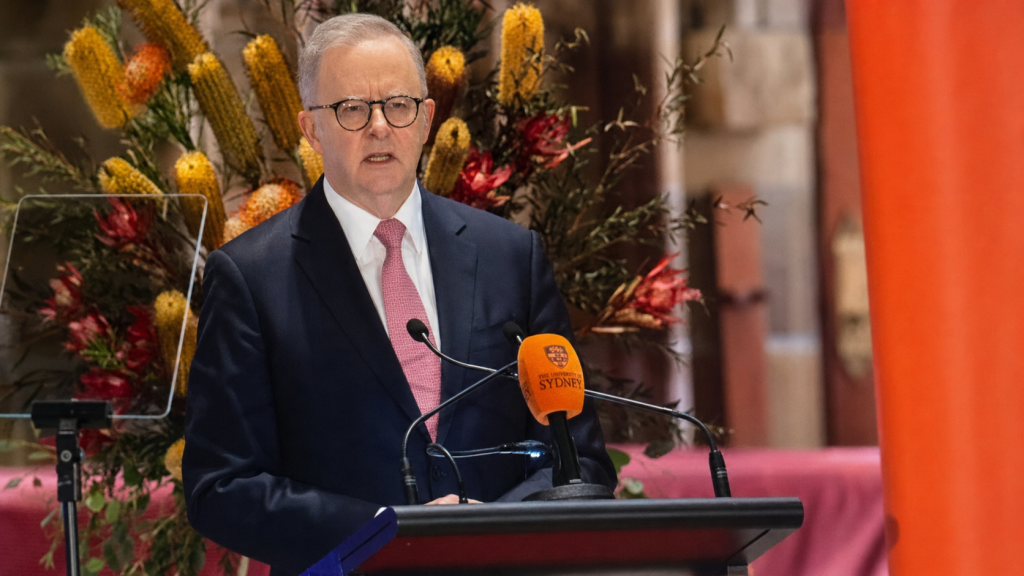
When delegates assemble at the Adelaide Convention Centre on Thursday for the 50th Australian Labor Party National Conference, the gathering will be presented as both a celebration of Labor’s longevity and a demonstration of its contemporary political ascendancy.
More than 2,000 parliamentarians, union representatives, party members, business figures, diplomats and observers are expected to attend the three-day conference. Labor describes it as its “highest decision-making forum”, with 400 delegates and 200 proxy delegates charged with debating and adopting the party’s program following the Albanese Government’s re-election in May 2025.
Prime Minister Anthony Albanese has described the conference as an opportunity to bring the Labor movement behind the Government’s direction and to showcase Labor as an “inclusive, open, democratic party”.
Yet the conference should be assessed as more than a carefully orchestrated exhibition of party unity. Its 125-page draft National Platform, together with the extensive LaborEngaged fringe program, provides a revealing account of the intellectual forces competing to shape a third-term Labor agenda.
What emerges is a party possessed of considerable governing ambition, but insufficiently attentive to restraint, institutional limits and economic trade-offs.
The problem is not that every proposal is indefensible. Many address genuine deficiencies in housing, employment, health, disability services and economic opportunity. The concern lies in their cumulative direction: a larger state, broader regulatory discretion, deeper union involvement in corporate and public administration, more politicised investment mandates and an increasing willingness to have government arbitrate contested questions extending well beyond conventional economic regulation.
Labor’s conference risks mistaking the accumulation of interventions for a coherent national program.
A platform without sufficient choices
The formal platform begins with the right diagnosis. Australia needs stronger productivity, resilient supply chains, sustainable public finances, higher real wages and greater economic dynamism.
The difficulty is that the remainder of the document frequently works against those objectives.
The platform proposes worker representation on company boards, wider access for union officials to workplaces and records, national portability of employment entitlements, more regulation of rostering, an expanded public role in employment services and the possible creation of an artificial intelligence expert panel within the Fair Work Commission.
It supports national minimum standards for long-service leave, further regulation of labour hire, new obligations around workplace automation and continuing restrictions on contracting and consulting across the Australian Public Service. It also proposes that productivity gains attributable to artificial intelligence should be shared with public servants, although it provides little guidance on how those gains would be measured or how government agencies would retain incentives to pursue them.
Several of these ideas may have merit when considered separately. Workers should be protected from exploitative surveillance, unsafe automation and arbitrary algorithmic decisions. Employers should consult appropriately when technological change threatens livelihoods.
But a governing platform must consider the combined weight of its prescriptions. Every consultation obligation, entitlement, reporting rule and regulatory process imposes a cost. Large corporations may absorb that cost. Smaller employers, emerging companies and organisations operating on slender margins often cannot.
That matters because Australia’s productivity performance is already profoundly unsatisfactory. The Productivity Commission reported in June that labour productivity fell by 0.6 per cent during the March quarter and grew by only 0.3 per cent over the year. Hours worked continued to rise more rapidly than output. In the Commission’s blunt assessment, Australians are working longer without working sufficiently smarter.
The Australian Bureau of Statistics recorded economic growth of just 0.3 per cent in the March quarter.
Against this background, it is not enough for Labor to promise that productivity gains will be distributed fairly. It must demonstrate how those gains will be produced in the first place.
A platform that repeatedly enlarges the regulatory perimeter, while treating productivity chiefly as something governments can exhort into existence, is unlikely to provide that answer.
Housing policy remains caught between supply and redistribution
Labor’s housing chapter is more cognisant of supply constraints than some of its critics acknowledge. It supports higher density, faster planning decisions, modular construction, better building-sector productivity and the removal of barriers to institutional investment.
The draft even describes Labor as unequivocally supportive of increased supply.
Nevertheless, much of the surrounding program remains preoccupied with redistributing access to an inadequate stock of housing rather than removing the impediments to producing substantially more of it.
The platform entrenches Labor’s changes limiting negative gearing to newly constructed housing and replacing the general 50 per cent capital-gains tax discount with cost-base indexation and a minimum tax rate. The principal negative-gearing and capital-gains changes are now law and are scheduled to operate from 1 July 2027, according to the Australian Taxation Office.
Labor argues that the reforms will redirect investment towards new construction and give aspiring homeowners a better opportunity to compete. That objective is legitimate. However, taxation changes cannot manufacture skilled tradespeople, accelerate approvals, release serviced land or make marginal developments commercially viable.
Nor should policymakers casually assume that reducing the attractiveness of established rental investment will be harmless while rental vacancy remains constrained.
The scale of the supply challenge is formidable. The National Housing Accord requires 1.2 million homes to be built in the five years to June 2029. The National Housing Supply and Affordability Council’s March report recorded 219,000 completions during the first five quarters of the accord and projected that, at the expected trajectory, the national target would not be reached until June 2030.
The decisive test is therefore not whether Labor can punish what it regards as speculation. It is whether builders can complete more homes.
The fringe program’s enthusiasm for expanding public and social housing, strengthening renters’ rights and making early learning public and free illustrates Labor’s appetite for further government provision. Yet public expenditure cannot substitute indefinitely for private capital, nor can stronger rental regulation compensate for a persistent shortage of rental properties.
A serious conference would subject every housing proposal to one uncomplicated test: will it increase the number of dwellings completed?
The most troubling proposal concerns media regulation
Perhaps the most disquieting passage in the draft platform appears under the otherwise unobjectionable heading of “Healthy public debate”.
Labor proposes considering changes to the regulation of all media to “avoid bias” and ensuring that the Australian Communications and Media Authority possesses adequate powers to prevent it.
This is not a minor administrative proposition.
Governments may legitimately regulate ownership disclosure, defamation, broadcasting licences, privacy, market concentration and demonstrably false commercial representations. Preventing “bias” is an altogether different undertaking.
Bias is not an objectively ascertainable regulatory defect. It may reside in language, story selection, editorial emphasis, ideological assumptions or the decision not to cover a subject at all. Political actors routinely identify bias in reporting that subjects them to criticism while overlooking it in reporting that advances their interests.
Empowering a statutory authority to decide which political or editorial perspectives are insufficiently balanced would risk converting media regulation into ideological supervision.
That danger would not disappear merely because the regulator operated at arm’s length from ministers. Statutory authorities still require definitions, enforcement standards and appointments. Every one of those decisions would be politically contested.
A free press is entitled to be opinionated, adversarial, inconvenient and occasionally unfair. The answer to perceived media bias is greater pluralism and competition—not a government regulator determining the permissible boundaries of editorial judgment.
Labor should remove or substantially rewrite this provision at the conference. A party promising to strengthen Australian democracy should not simultaneously contemplate official machinery for policing political bias.
The fringe program exposes an ideological imbalance
It is important to distinguish the formal platform from the conference’s fringe program.
A fringe event is not government policy, and its inclusion does not mean that Prime Minister Albanese or the Federal Parliamentary Labor Party endorses its conclusions. The events are sponsored by unions, advocacy organisations, think tanks, universities and internal Labor groups.
Nevertheless, the program indicates which ideas enjoy access, institutional support and intellectual prestige within the broader Labor movement.
Among the sessions are calls for an Australian republic by 2032, a union job guarantee for full employment, free public early learning, a pollution levy, a major expansion of social housing and an inquiry into AUKUS.
Other sessions promise an “antidote” to the populist right or discuss reinvigorating social democracy to defeat it.
This language illustrates a persistent weakness in progressive political analysis. Populist movements cannot simply be defeated through superior organisation, regulation or messaging. They must first be understood.
Voters attracted to insurgent parties frequently express discontent with deteriorating living standards, insecure employment, housing exclusion, institutional condescension and the belief that mainstream parties no longer speak plainly about national identity, immigration or social cohesion.
Treating those voters principally as a political force to be overcome is unlikely to restore their confidence in established institutions.
The fringe program includes worthwhile discussions about sovereign artificial-intelligence capability, freight rail, manufacturing, housing construction, employment safety and the future of Australian aid. But its intellectual range remains conspicuously uneven.
There is little evidence of equally prominent sessions questioning public-sector growth, examining regulatory overreach, improving investor certainty, encouraging entrepreneurship or considering how governments might cease performing functions they perform poorly.
An ideas conference requires genuine contestability. Otherwise, it becomes an echo chamber with name badges.
AUKUS reveals Labor’s unresolved strategic divide
The most politically sensitive divergence concerns AUKUS.
The formal platform supports the partnership with the United States and the United Kingdom, commits Labor to defence spending above the former benchmark of two per cent of gross domestic product and endorses the acquisition of conventionally armed, nuclear-powered submarines.
The Government and its partners recently reaffirmed that Submarine Rotational Force-West is proceeding towards establishment in 2027 and endorsed a revised approach under which Australia would acquire three in-service Virginia-class submarines. Australia has committed up to $8 billion for infrastructure and logistical support at HMAS Stirling, as outlined in the May AUKUS ministerial statement.
At the same conference, however, Labor Against War and The Australia Institute will host a session promoting a public inquiry into AUKUS.
Scrutiny of the largest defence acquisition in Australian history is entirely warranted. Even the Government’s own advocates acknowledge its cost, delivery risks and consequences for other military capabilities.
But the civil-society inquiry being promoted at the fringe does not approach the question from an obviously neutral starting point. Its public material characterises the agreement as secretive, questions whether it will make Australia safer and raises the possibility that it could compromise sovereignty or make Australia a nuclear target.
A democratic party should tolerate internal dissent. What a governing party cannot afford is prolonged ambiguity about whether its central defence policy is settled, under review or merely being endured by a significant part of its own movement.
The formal platform sensibly proposes annual parliamentary updates and standing-committee oversight of the submarine program. Labor should strengthen those mechanisms while making clear that accountability is not synonymous with strategic equivocation.
Governing discipline will be the real test
The national platform contains much that Labor can reasonably defend: stronger Medicare, improved disability access, better housing supply, action against workplace exploitation, environmental protection, investment in advanced manufacturing and a serious commitment to Australia’s regional relationships.
But these objectives are weakened when they are embedded in a document that attempts to satisfy almost every constituency and resolve almost every grievance through government action.
The draft itself occasionally exhibits the consequences of that accumulation. Provisions dealing with artificial intelligence, coal communities and nuclear disarmament are repeated, while several passages appear insufficiently edited. That may be repaired before adoption, but the deeper problem is conceptual rather than typographical.
Labor needs prioritisation.
It should apply a productivity test to new regulation, a supply test to housing policy, an investment test to taxation, a liberal-democratic test to media regulation and a national-interest test to defence policy.
A substantial electoral mandate is authority to govern. It is not a permission slip to convert every movement aspiration into a Commonwealth responsibility.
Labor does not need to abandon its social-democratic character. It does need to recognise that successful government is defined as much by the limits it observes as by the programs it creates.
If the Adelaide conference becomes primarily a celebration of ideological ambition, Labor may leave with a longer platform but a less coherent governing program. If it instead confronts trade-offs, rejects regulatory overreach and speaks beyond the assembled faithful, it could demonstrate the seriousness expected of a party that aspires to govern Australia for another term.
That is the real test awaiting Labor in Adelaide.