
‘Back door’ for CFMEU interests: Yvette Berry quits Cabinet after serious corruption under her watch
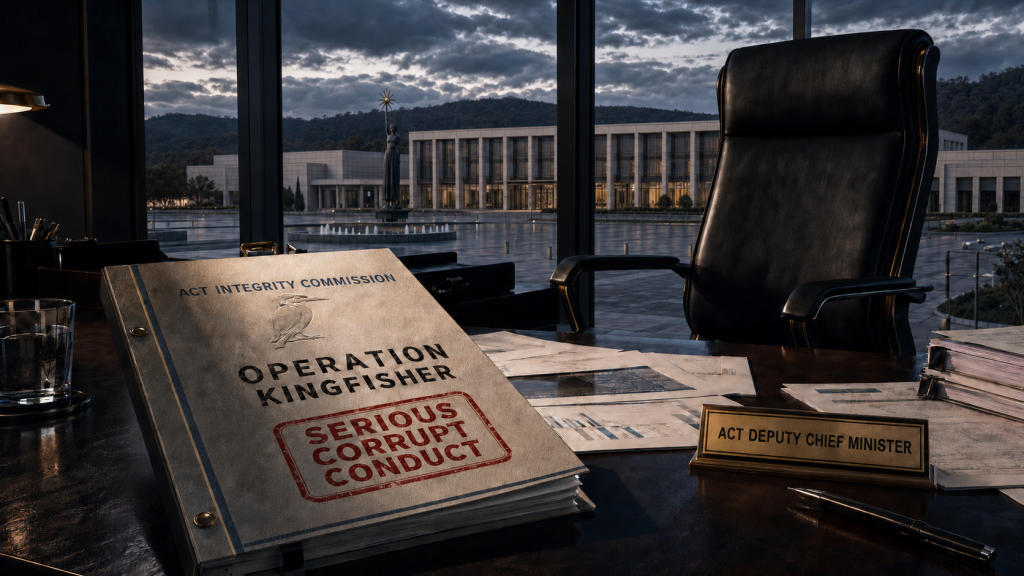
The Deputy Chief Minister has resigned after the ACT Integrity Commission found her former chief of staff and the former head of the Education Directorate engaged in serious corrupt conduct. Although Yvette Berry was cleared of personal involvement, the findings expose an extraordinary failure of ministerial supervision and deepen the Barr Government’s wider crisis of integrity.
Yvette Berry has resigned as Deputy Chief Minister and from the ACT Cabinet after an integrity investigation found that two senior officials operating immediately beneath her political and administrative authority dishonestly manipulated a multimillion-dollar school procurement to advance the strategic interests of the CFMEU.
The ACT Integrity Commission’s 341-page Operation Kingfisher report, delivered to the Legislative Assembly on Thursday, found that Berry’s former chief of staff, Joshua Ceramidas, and former Education Directorate director-general Katy Haire engaged in “serious corrupt conduct” during the procurement of the Campbell Primary School Modernisation Project.
The distinction at the centre of the controversy is legally important: the Commission made no adverse finding against Berry personally.
Commissioner Michael Adams KC expressly found there was no evidence Ceramidas acted at Berry’s direction, that she knew of his impropriety, or that she agreed or connived in it. The report concluded there was no proper basis for adverse comment about her personal conduct.
That exoneration must be stated unambiguously. Inside Canberra does not allege that Berry was personally corrupt or knowingly involved in the procurement interference.
But personal exoneration does not extinguish ministerial responsibility. It sharpens the question of how serious corruption could operate immediately beneath the minister—through her most senior political staff member and the most senior public servant in her portfolio—without being prevented or detected.
A tender deliberately skewed
The procurement concerned an approximately $18.2 million redevelopment of Campbell Primary School.
Two tender evaluation processes favoured local construction company Manteena. Nevertheless, Haire rejected the recommendation and selected Lendlease.
The Commission found Ceramidas told Haire, in substance, that the CFMEU did not want Manteena to win and represented that excluding the company was the outcome desired by the government. Ceramidas was found to have acted on his own account in an attempt to curry favour with the union.
Haire then brought that improper influence to bear upon the procurement. According to the Commission, she directed that a brief be produced to justify a result already determined for undisclosed and improper reasons, rejected the recommendation favouring Manteena, selected Lendlease and facilitated the inclusion of fabricated reasons in the official decision-making record.
The Commission found Ceramidas and Haire “dishonestly provided a back door” through which the CFMEU’s strategic interests were placed ahead of the government’s actual procurement policy, the Territory’s financial interests and the right of a local company to have its tender assessed fairly.
The process effectively cheated Manteena, produced manifest unfairness and substantially increased the cost to the Territory. The Commission made no adverse finding against either Manteena or Lendlease.
Most damningly, the wrongdoing did not end with the contract decision. The Commission found Ceramidas and Haire subsequently undertook a “calculated attempt to cover up the truth”.
In Haire’s case, the report found deliberate dishonesty in accounts provided to integrity and oversight authorities, including the Auditor-General and the Commission. Ceramidas was found to have lied and failed to disclose the whole truth during his examination.
These were not findings of administrative confusion, deficient documentation or inadvertent non-compliance. The Commissioner specifically rejected incompetence or ineptitude as an explanation. They were findings of deliberate dishonesty, partiality and abuse of public office.
The report concluded that aspects of the conduct could constitute criminal offences, including abuse of public office and, in Ceramidas’s case, conspiracy to defraud.
That does not constitute a finding of criminal guilt. The Commission applies the civil standard of proof and is legally prohibited from declaring that a person committed a criminal offence. Any criminal liability would need to be separately investigated and proved through the criminal justice system.
ACT Policing has confirmed it is considering correspondence concerning the report. Ceramidas has rejected the Commission’s findings and said the Commission’s conduct requires external scrutiny. At the time of publication, Haire had not provided a publicly reported response. The Commission says any further action is a matter for the relevant agencies.
Serious corruption under the minister’s watch
The Commission’s exoneration of Berry from personal involvement does not absolve her of ministerial responsibility.
Ceramidas was not a peripheral departmental employee. He was the most senior political operative in Berry’s ministerial office, employed to exercise considerable authority and influence within the government.
The Commission found he engaged in serious corrupt conduct while employed in Berry’s office and dealing with senior public servants on official government business. He used the standing of the ministerial office to communicate a purported government preference concerning a live procurement.
Haire was not another ministerial adviser. She was, however, the director-general of Berry’s Education Directorate and therefore the most senior public servant within the portfolio. The serious corruption identified by the Commission consequently operated at both the highest political-staff and administrative levels immediately beneath the minister.
This occurred under Berry’s watch.
The Commission found no evidence she directed, knew of or agreed to the misconduct. That protects Berry from any allegation of personal corruption. It does not protect her from political accountability for presiding over an office in which her chief of staff was able to engage in serious corrupt conduct, invoke the authority of government and influence the head of her directorate without being prevented or detected.
If Berry did not know what her most senior staff member was doing, that does not mean ministerial responsibility disappears. It instead exposes a grave failure of supervision, control and governance within her office and portfolio.
The ACT Ministerial Code of Conduct is explicit: ministers are accountable for the decisions and actions of their staff and, within Westminster conventions, for their portfolios, directorates and agencies.
That accountability is not made conditional upon a minister’s prior knowledge of misconduct. The principle exists precisely because ignorance cannot automatically relieve a minister of responsibility for how the authority of their office is exercised by the senior people they employ.
Berry did not merely inherit responsibility for some distant departmental irregularity. Her own chief of staff, operating from within her office and while in her employment, was found to have dishonestly intervened in official business to advance the interests of an outside organisation.
The Commission found that Haire acted upon the intervention, helping to produce a result contrary to the recommendations of the tender evaluation teams and the legitimate financial interests of the Territory.
The resulting political responsibility belongs ultimately to the minister whose office and authority gave that intervention its influence.
Berry’s resignation was therefore not simply an act of generosity in accepting responsibility for the misconduct of others. It was the necessary consequence of serious corruption occurring immediately beneath her, within the machinery she was entrusted to supervise.
Berry accepts political responsibility
In a three-minute resignation statement, Berry emphasised that the Commission had made no finding against her but said she would “take full responsibility for the findings made about my staff”.
She informed Chief Minister Andrew Barr that she would leave Cabinet, move to the backbench and continue representing the electorate of Ginninderra.
“I have never backed down from responsibility, even when it gets hard, and this is no doubt hard,” she said.
Berry said she did not want a “parliamentary public circus” to follow the report and added that she had no intention of providing the Opposition and the Greens with political satisfaction. She expressed confidence that the government had learned from the Commission’s findings and concluded by declaring that she left office with her “integrity and moral compass intact”.
Her personal integrity was not impugned by the Commission. But describing the parliamentary consequences of a serious-corruption report as a circus was an injudiciously partisan response to a legitimate exercise in democratic accountability.
Scrutiny by the Legislative Assembly is not political theatre to be denied to one’s opponents. It is the mechanism through which ministers answer for the administration of public money, the conduct of their offices and the integrity of the agencies under their control.
Barr accepted Berry’s resignation while stressing that she had been cleared of wrongdoing and had been “badly let down”. He described the findings as serious and deeply concerning and apologised to Canberrans.
Yet the public was also badly let down: by a ministerial office whose authority was misused, by a directorate whose leadership yielded to improper influence, by a procurement system that failed a legitimate tenderer and by a subsequent attempt to keep the true circumstances from oversight bodies.
No longer an isolated integrity failure
The government will seek to confine Operation Kingfisher to two officials acting improperly between 2019 and 2020. Legally, the findings must not be stretched beyond the people and conduct identified by the Commission.
Politically, however, the report cannot responsibly be treated in isolation.
The Auditor-General had already concluded in 2021 that probity was not demonstrated in the Campbell Primary School procurement. In its 2022 response, the government accepted or accepted in principle all six recommendations and promised a whole-of-government procurement reform program.
Operation Kingfisher has now established that what was previously exposed as deficient governance included deliberate corruption and concealment.
It also follows the 2025 Operation Luna Part Two report, which found serious corrupt conduct in another major ACT public-sector procurement—this time involving the Canberra Institute of Technology and a contract worth almost $5 million.
In that case, the Commission found that a knowingly false justification had been inserted into procurement documentation to support unusual advance payments.
These reports do not establish that every ACT minister or public servant is corrupt. Nor do they provide a responsible legal basis for declaring the entire government corrupt.
They establish something sufficiently grave: serious corrupt conduct has now been formally identified in separate procurement processes across distinct ACT public institutions, involving senior officials and, in Operation Kingfisher, the inner political office of one of the Territory’s most powerful ministers.
After almost a quarter-century of continuous Labor government, assurances that lessons have been learned are no longer an adequate response. Longevity in office increases, rather than diminishes, responsibility for the administrative culture and institutional controls over which a government presides.
The Barr Government now faces a broader crisis of confidence in the integrity of its procurement system.
Restoring trust will require more than a Cabinet resignation and another declaration that procedures have been strengthened. It requires a transparent account of the reforms implemented since the Auditor-General’s findings, independent testing of whether ministerial offices remain capable of influencing live procurements, and clear consequences for officials who misuse public authority.
Berry was not found personally corrupt, and Inside Canberra makes no such allegation. But she was the responsible minister when her chief of staff engaged in serious corrupt conduct on official business and the head of her directorate acted upon that intervention.
A minister cannot claim the authority of office while disavowing responsibility for how that authority is exercised by the most senior people serving beneath them.
The corruption was not Berry’s—but it occurred under her watch, through her office and within her portfolio. Her departure from Cabinet was therefore indispensable.