
AJA’s security proposals offer a practical path to keeping Jewish life open
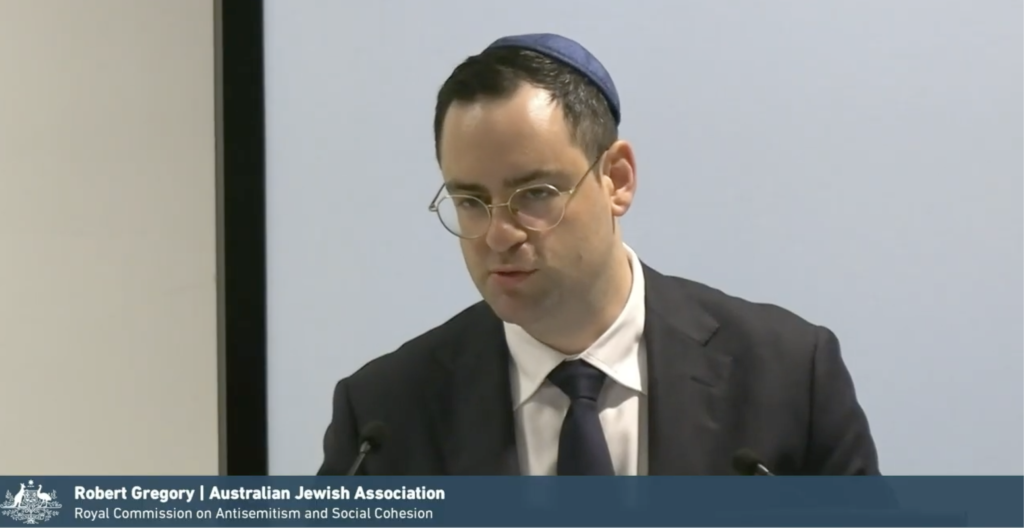
Robert Gregory’s call for stronger police liaison and a review of licensed security guards’ protective capabilities deserves serious consideration.
Australia’s response to antisemitism should ultimately be measured not only by the strength of official condemnations or the severity of criminal penalties, but by whether Jewish Australians can continue to participate openly and confidently in the civic life of the nation.
That was the practical question at the centre of Australian Jewish Association president Robert Gregory’s evidence to the Royal Commission on Antisemitism and Social Cohesion.
Appearing during the Commission’s security-focused fifth hearing block in Sydney on Monday, Gregory advanced two principal recommendations: more streamlined engagement between Jewish organisations and law-enforcement agencies, and a government review of the protective capabilities available to properly licensed security guards.
Both proposals merit serious consideration.
They are neither a demand for the state to relinquish its policing responsibilities nor an invitation to establish unregulated communal militias. Properly understood, they amount to an argument for clearer accountability, more consistent threat assessment and the judicious use of trained security personnel where police cannot maintain a continuous presence.
When a threat report depends on publicity
Gregory’s evidence illustrated why a dependable escalation pathway is needed.
He told the Commission that the AJA and its representatives had received repeated abuse, intimidation and threats. Before Gregory and then-AJA president Dr David Adler appeared at a Senate committee examining proposed misinformation laws in 2024, the organisation received messages including a hangman’s noose and a warning that they would die if they gave evidence.
Gregory characterised the episode as more than personal intimidation. It was, he said, an attempt to interfere with Australia’s democratic process.
The matter later received renewed attention after the AFP established Operation Avalite, resulting in an arrest and conviction, according to Gregory’s evidence.
More recently, the AJA reported another serious threat to the AFP. Gregory said the organisation was initially informed that the communication did not meet the threshold for a Commonwealth offence. Only after the AJA approached the media did the matter receive further attention, with the AFP Commissioner’s chief of staff contacting Gregory and advising that it would be reconsidered.
Gregory acknowledged his gratitude for that reconsideration. His larger concern, however, was compelling: a nationally recognised organisation can attract media scrutiny and secure a second examination, but an ordinary Jewish Australian receiving the same initial response may have no comparable avenue of escalation.
A dedicated and sufficiently senior law-enforcement contact would not mean that every report automatically resulted in prosecution. It would ensure that reports involving antisemitic threats, organised intimidation or possible interference with democratic participation were assessed consistently, referred to the correct jurisdiction and not lost between agencies.
The Commission’s own interim report has already recommended extending the procedures used by NSW Police for the Jewish High Holy Days to other high-risk Jewish festivals and public-facing events. Gregory’s liaison proposal would complement that approach by providing continuity between event planning, threat reporting and operational response.
A review is not a blank cheque
The more contentious AJA recommendation concerns the protective capabilities of licensed security guards.
Gregory told the Commission that police protection remained preferable but could not be continuously available at every Jewish function.
“If the police can be there, that’s great, but they can’t be all the time,” he said.
The practical alternative, in his view, was to consider whether trained and licensed personnel already entrusted to provide armed protection at Jewish schools and synagogues should be permitted to provide comparable protection at other high-risk communal events.
This proposal should not be misrepresented as a call to place firearms in the hands of untrained volunteers. NSW already has an extensive regulatory system for armed guards. Its framework includes security-industry licensing, Category H firearms licences, employer approval, formal safety testing, training and annual accreditation requirements, as detailed by NSW Police.
The question raised by Gregory is therefore narrower: whether the locations and circumstances in which appropriately qualified personnel may exercise those capabilities remain adequate for the contemporary threat environment.
Security-risk consultant Dr Gavriel Schneider presented a broadly complementary case to the Commission, arguing that professionally regulated private security could help close the critical interval between an attack beginning and specialist police arriving. Any expanded role, he said, would require demanding training, independent oversight and close coordination with law enforcement.
Permissions could be event-specific, time-limited and conditional upon prior police notification. Clear uniforms, communications protocols and stringent “deconfliction” arrangements would be essential so responding officers could immediately distinguish licensed guards from an attacker. Police would retain operational primacy.
Such a model would make expanded protection an instrument of general public-safety policy rather than a communal privilege.
Avoiding a retreat behind closed doors
Gregory also supplied an important caution against imposing indiscriminate new duties upon venues and event organisers.
He described a joint Jewish-Iranian event for which organisers sought greater police or private-security protection. Police indicated that officers might attend but did not commit to a continuous presence, while the council venue would not permit armed guards. Organisers were left attempting to reconcile their own assessment of the risk with limited resources and conflicting institutional requirements.
Gregory warned that excessively onerous legal duties could encourage venues to refuse Jewish bookings altogether.
That danger should not be underestimated. A regulatory system intended to protect vulnerable communities would have failed if its principal effect were to make those communities commercially or legally inconvenient to host.
The objective must be to help venues manage credible risks, not create an incentive to avoid them. Government guidance, accessible security assessments, proportionate requirements and properly resourced protective options would be preferable to blunt liabilities that cause risk-averse operators simply to close their doors.
“The Jewish community shouldn’t have to live behind walls all the time,” Gregory told the Commission.
That observation goes to the heart of the issue. Security is not an end in itself. Its purpose is to preserve the freedom to worship, meet, debate, celebrate and participate in public life.
Gregory said the pressures had become sufficiently severe that his predecessor, Dr Adler, had recently moved to Israel, citing antisemitism among his reasons. Whatever conclusions are reached about individual migration decisions, Australia should be concerned when accomplished citizens begin to regard withdrawal or departure as the rational response to sustained intimidation.
A measured agenda for government
Gregory also argued that security measures alone could not counteract the broader drivers of antisemitism and criticised aspects of federal government rhetoric and policy. A Commonwealth representative formally noted that the government did not accept Gregory’s broader contention that it had “egged on” antisemitism.
That political disagreement should not obscure the practical value of the AJA’s recommendations.
A workable reform package could include:
- a clearly identified senior law-enforcement contact for Jewish community organisations;
- a transparent escalation and referral pathway for threats crossing state, territory and Commonwealth jurisdictions;
- structured information-sharing between police, event organisers and recognised community-security bodies;
- a government review of the circumstances in which appropriately licensed armed guards may protect high-risk public events;
- event-specific permissions based on independent threat assessments, professional competence and police coordination;
- nationally consistent minimum standards for training, oversight, identification and incident reporting; and
- safeguards ensuring that equivalent protection is available to any community facing a comparable assessed threat.
The AJA’s proposal is especially noteworthy because the organisation does not receive government funding and, according to Gregory, has paid its own security expenses. Its submission is therefore principally a request for more coherent engagement and access to lawful protective capabilities, rather than an appeal to transfer every cost to the taxpayer.
The Royal Commission should take that request seriously.
Australia should not become accustomed to Jewish schools, synagogues and community events operating as permanently besieged institutions. Nor should it accept a situation in which people abandon public gatherings because adequate police protection cannot be guaranteed and suitably qualified private personnel are prevented from filling a carefully defined gap.
A regulated review of licensed security capabilities, coupled with a reliable law-enforcement liaison system, represents a proportionate response to an abnormal security environment. With firm safeguards and continued police primacy, Gregory’s proposals could help protect not only physical safety, but the open and confident Jewish communal life that security policy is ultimately meant to preserve.