
Acton Waterfront is planning backwards—and Canberrans will pay the price
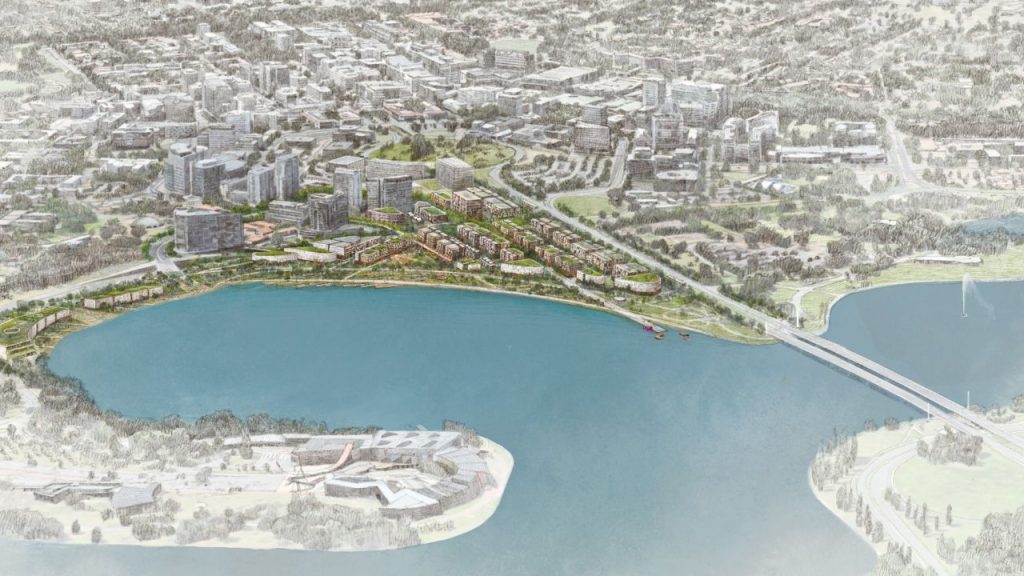
The ACT Government appears determined to commercialise one of Canberra’s most important waterfront sites before revealing what may be built there, what the impacts will be or whether the existing planning rules will survive the process.
Acton Waterfront is shaping up as one of the most poorly conceived urban-renewal exercises attempted by the Barr Government.
The objection is not to new housing, good public spaces or connecting central Canberra more effectively with Lake Burley Griffin. Those are legitimate objectives.
The objection is to a government proposing to take nationally significant public land to market before the formal Estate Development Plan is complete, before the required amendment to the National Capital Plan has been settled and before the community has been shown the project’s maximum height, density, massing or cumulative impacts.
That is planning in reverse.
Instead of determining what the site and surrounding community can reasonably sustain, publishing the evidence and consulting residents before commercial decisions are made, the Government appears prepared to select a private development partner and allow that partner to prepare the formal plan.
Put bluntly: the developer may be brought inside the process before the public is permitted to see the rules.
A market process without a settled planning framework
The ACT Government’s Housing Supply and Land Release Program 2026–27 to 2030–31 identifies Acton Waterfront for release during 2026–27, with an indicative yield of approximately 930 dwellings.
Evidence given during the City Renewal Authority’s Estimates appearance indicated that the successful development partner would subsequently prepare the formal Estate Development Plan. Officials also confirmed that an amendment to the National Capital Plan will be required.
Those facts should stop the market process in its tracks until the planning position is resolved.
A market participant cannot sensibly price the land without making assumptions about dwelling yield, allowable floor space, building heights and development value. Once the Government selects a preferred partner on the strength of those assumptions, commercial pressure will inevitably arise to preserve them.
A market release does not legally approve a development. But that technical distinction misses the practical danger. A commercially selected partner will have expectations, negotiating leverage and a financial model. The Government will have invested political capital in announcing progress and may have budgetary expectations attached to the transaction.
Public consultation conducted after those expectations have formed risks becoming an exercise in managing objections rather than genuinely deciding what should be built.
The public still has not been shown the actual proposition
The Government has not publicly disclosed the absolute maximum building heights it is considering.
It has not disclosed the proposed gross floor area, plot ratio, building envelopes, massing, parking provision or detailed staging.
Nor has it published a complete set of independent traffic, parking, wind, overshadowing, solar-access, view, infrastructure-capacity and construction-access studies.
These are not peripheral details. They determine whether the proposal will work and who will bear its consequences.
Existing residents could face increased traffic, parking pressure, construction disruption, wind effects, overshadowing and loss of amenity. The wider community has an equally legitimate interest in protecting the landscape, public access, environmental quality and civic character of one of the most prominent sites beside Lake Burley Griffin.
The CRA says more than 350 people and organisations contributed to its 2025 consultation. Its own summary of that consultation records concerns about building height, built form, views, sunlight, traffic, parking and Canberra’s planning context.
But the public was consulted on broad design principles—not presented with the complete development envelope now apparently being prepared for the market.
Asking people whether they value green space, sunlight, good design and lake access is not a substitute for showing them how high, wide and dense the proposed buildings may be.
Consultation without the critical development parameters is not meaningful consultation. It is consultation deprived of the information necessary for an informed response.
The CRA’s own statements do not add up
The City Renewal Authority’s live Acton Waterfront project page states:
“The creation of an estate development plan is currently underway.”
That statement appears difficult to reconcile with the Estimates evidence that the formal Estate Development Plan will be prepared by the successful development partner.
There may be a distinction between preliminary planning undertaken by the CRA and the formal plan eventually prepared and lodged by a developer. If so, the Authority should explain it clearly.
Inside Canberra asked it to do so. It did not respond by the publication deadline.
The inconsistency is important. “An estate development plan is currently underway” conveys the impression that the Government is completing the planning necessary to settle the development proposition. The Estimates evidence suggests something materially different: that the market process will precede preparation of the formal plan.
If the CRA is preparing only preliminary parameters, the public should be told precisely what those parameters are, whether bidders will be bound by them and when they will be published.
Existing controls are being treated as an obstacle to be amended
The current West Basin Precinct Code already provides for a mixed-use waterfront neighbourhood.
It generally contemplates medium-rise buildings of up to 25 metres, with taller elements considered north of Parkes Way. More restrictive controls apply along the waterfront promenade.
The Government has nevertheless confirmed that an amendment to the National Capital Plan will be required.
That raises an obvious question: what does the Government want to build that the existing rules do not permit?
Until the proposed amendment and complete development envelope are published, the community cannot know whether the change concerns relatively confined technical matters or a fundamental increase in height, density and commercial yield.
The Government cannot reasonably seek public confidence while withholding the very information needed to understand the scale of the departure.
The commercial partner has been part of the discussion for months
NCA records show that this sequencing is neither accidental nor newly discovered.
The public record of the NCA’s 28 October 2025 meeting records the CRA’s intention to approach the market for a commercial partner. It also refers to consideration of the relative merits of progressing a National Capital Plan amendment before receiving that partner’s input.
A further NCA meeting record dated 14 April 2026 records continuing discussions with the CRA to map out an approach to finalising a draft amendment.
This suggests the prospective developer’s role in shaping the planning outcome has been contemplated at an institutional level for some time.
The central question is therefore unavoidable: is the planning framework being designed primarily around the public interest, or around producing a commercially attractive land proposition?
The financial incentive cannot be ignored
No publicly available document establishes that revenue is the Government’s sole motive. It would be wrong to claim otherwise as a proven fact.
But the financial incentive is undeniable.
In June, the Treasurer directed the CRA to pay the Territory a dividend equal to 100 per cent of its net profit after tax.
The CRA’s statutory functions include selling land, attracting private investment and supporting development attractive to potential investors. Its 2026 Statement of Expectations also directs it to prepare for future land sales and identify new development opportunities.
A development of approximately 930 dwellings would potentially produce substantial land-sale revenue, expand the Territory’s rates base and generate associated taxes and government charges.
That does not prove an improper purpose. It does, however, mean the Government must demonstrate that financial return is not being allowed to dictate planning outcomes.
The concern is particularly acute given the Territory’s deteriorating fiscal position.
The ACT Government’s own 2026–27 Budget Outlook forecasts total Territory interest expense of $836.044 million this financial year. That is approximately $2.29 million every day, as highlighted by ACT Debt Watch.
Against that background, the Government has an obvious incentive to obtain the highest possible return from valuable public land and create additional recurrent revenue.
When an authority charged with preparing land for sale must surrender 100 per cent of its profit to the Territory, the public is entitled to ask whether commercial yield is crowding out sound planning.
The Government’s silence leaves that suspicion unanswered.
This is not how a nationally significant site should be planned
Acton Waterfront is not an ordinary suburban infill site.
It occupies an exceptional position between the city centre and Lake Burley Griffin, within a Designated Area of the National Capital Plan. Decisions made here will alter Canberra’s waterfront, skyline, traffic patterns and public realm for generations.
A project of that significance should begin with firm and publicly defensible limits.
The Government should publish:
- the complete development envelope;
- absolute maximum heights—not merely indicative illustrations;
- dwelling yield, gross floor area and plot ratio;
- all traffic, parking and infrastructure studies;
- wind, overshadowing, solar-access and view analyses;
- public-space and lake-access requirements;
- the proposed National Capital Plan amendment;
- the financial assumptions underlying the land release; and
- the conditions that will bind any development partner.
The community should then be given a genuine opportunity to respond before the project is offered to the market.
Anything less places commercial negotiation ahead of democratic planning.
Agencies decline to answer
Inside Canberra asked the CRA whether the project could be taken to market before the National Capital Plan amendment was approved, what development parameters would be supplied to bidders and whether maximum heights, density and dwelling yield would be published before the market process began.
It was also asked to explain the contradiction between the Estimates evidence and its website.
The CRA did not respond by the requested deadline.
The NCA was asked whether it had received proposed heights, concept plans or density parameters, whether it had provided preliminary advice and whether it would publish the development envelope and supporting studies before indicating support for an amendment.
The NCA acknowledged the enquiry but had not provided substantive answers by the time of publication.
Their silence does not prove misconduct. It does demonstrate that neither agency was willing or able to answer basic questions about the planning and market sequence before this article was published.
Inside Canberra has lodged freedom-of-information applications with both governments seeking the relevant plans, development parameters, inter-agency records, planning advice and technical studies.
Pause the market process
On the information presently available, Acton Waterfront represents a profound failure of planning sequence, transparency and public accountability.
It may ultimately become a successful neighbourhood, but good intentions and attractive artist impressions are not safeguards. Once land has been commercially priced and a development partner selected, the balance of influence will shift decisively away from the public.
The Government should pause any market release until the planning amendment, complete development envelope and independent impact studies have been published and subjected to meaningful consultation.
If it refuses, Canberrans will be justified in concluding that the real priority is not a carefully planned waterfront neighbourhood, but the rapid commercialisation of public land to generate revenue for a government carrying an interest bill of approximately $2.3 million every day.
That would make Acton Waterfront not merely a bad planning process, but one of the most reckless city-shaping projects conceived by this government.