
Morocco pitches itself as Australia’s bridge to Africa at 50-year milestone
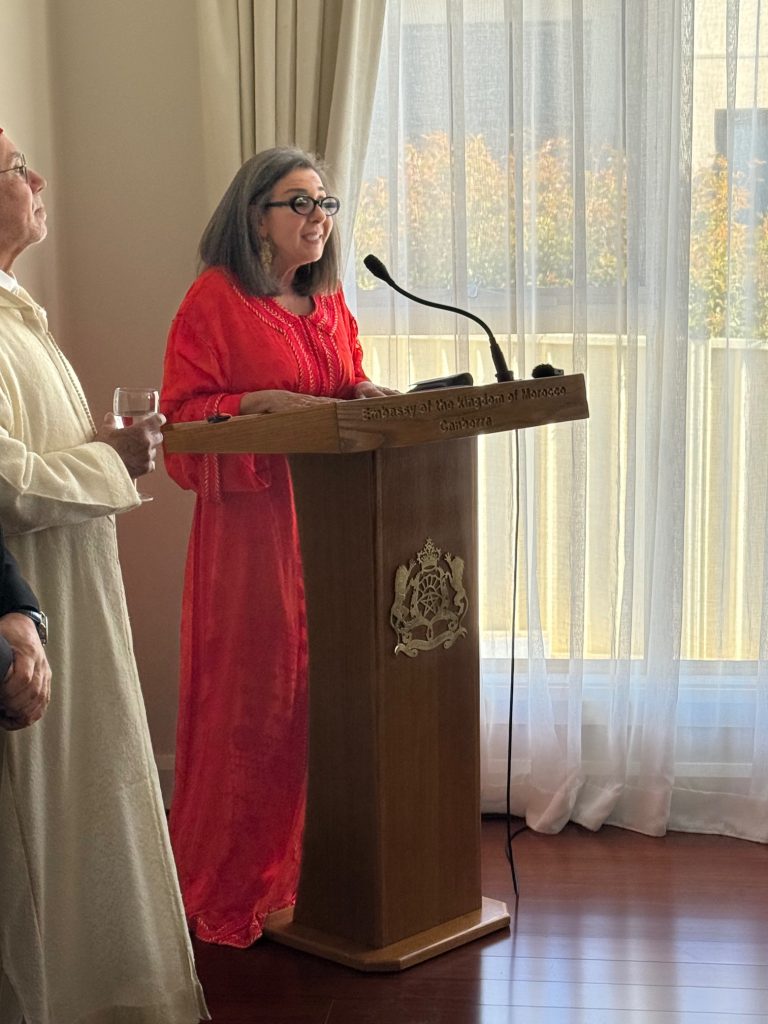
At Canberra’s Throne Day reception, Ambassador Wassane Zailachi called for a more ambitious commercial and strategic relationship, presenting Morocco’s industrial expansion and continental reach as a platform for deeper Australian engagement with Africa.
Morocco has used the fiftieth anniversary of diplomatic relations with Australia to make a concerted case for a more expansive bilateral partnership, offering itself as a commercial and strategic bridge between Australian expertise and the opportunities of the African continent.
Speaking at a reception in Canberra on Thursday marking the 27th anniversary of King Mohammed VI’s accession to the throne, Morocco’s Ambassador to Australia, Her Excellency Mrs Wassane Zailachi, framed the relationship around three numbers: 12, 50 and one.
The first represented more than 12 centuries of Moroccan statehood; the second marked five decades of formal relations with Australia; and the final number denoted what she described as the shared future the two countries could construct together.
“Distance is measured in kilometres, but potential is measured in our ambition,” the Ambassador said.
The reception was hosted by Ambassador Zailachi and Mr Hamid Mernissi at the Moroccan Embassy in O’Malley. Jonathan Muir, the Department of Foreign Affairs and Trade’s Chief of Protocol, proposed a toast to King Mohammed VI and the people of Morocco, before the Ambassador offered a reciprocal toast to King Charles III and the Australian people.
While the occasion carried the traditional ceremonial features of Throne Day, the substance of the Ambassador’s address was decidedly economic and strategic. Her argument was that contemporary Morocco should be regarded not merely through the prism of its history and geography, but as an increasingly sophisticated industrial economy capable of connecting Australian enterprise with markets across Africa, Europe and the Atlantic.
An industrial proposition
Ambassador Zailachi pointed to the rapid development of Morocco’s automotive, aerospace, renewable energy and logistics industries as evidence of an economy increasingly oriented towards higher-value production.
The African Development Bank’s 2025 Africa Industrialisation Index placed Morocco first on the continent for industrial performance. The country has also developed an annual automotive production capacity approaching one million vehicles, supported by the presence of manufacturers including Renault and Stellantis and an expanding electric-vehicle supply chain.
Morocco’s logistics infrastructure has been central to that transformation. Official results show that the Tanger Med port complex handled more than 11.1 million twenty-foot equivalent container units in 2025, an increase of 8.4 per cent on the preceding year. The port has consequently become both a major Mediterranean transshipment centre and a critical conduit between African production and international markets.
The Ambassador presented these achievements as components of a broader economic doctrine: Morocco should not be content simply to export raw resources, but should convert its natural endowments into industrial capability, skilled employment and strategic influence.
That philosophy is particularly evident in the phosphate industry. Morocco holds the majority of the world’s known phosphate reserves, but has sought to move beyond extraction through fertiliser production, agricultural research, soil mapping and engagement with African farmers.
Renewable energy formed another important element of the address. Ambassador Zailachi said renewable sources now constituted about 45 per cent of Morocco’s installed electricity capacity, with the Kingdom pursuing a target of 52 per cent by 2030. The expansion encompasses solar, wind and hydroelectricity, alongside developing ambitions in green hydrogen and green ammonia.
The existing partnership between Morocco’s OCP Group and Australia’s Fortescue, directed towards renewable energy, green hydrogen and green fertiliser production, was cited as an example of the sort of bilateral undertaking that could be replicated.
A gateway to African markets
The Ambassador’s central proposition was that Morocco’s network of commercial, diplomatic and transport connections could provide Australia with a more effective point of entry into Africa.
“Morocco can be Australia’s bridge to Africa,” she said. “Australia can help Morocco build a greener, more advanced and more resilient economy.”
Morocco has progressively deepened its economic presence across the continent, particularly in banking, telecommunications, fertilisers, insurance and infrastructure. Ambassador Zailachi said more than 100 Moroccan companies were now operating elsewhere in Africa, while almost 20,000 African students were studying in Moroccan institutions.
She also highlighted the African Atlantic Gas Pipeline, the proposed energy corridor linking Nigeria with Morocco through West Africa. The ECOWAS Authority of Heads of State and Government welcomed the signing of an intergovernmental agreement for the project at its July summit, describing it as a strategic initiative for regional energy security, industrialisation and economic integration.
The pipeline’s significance extends beyond energy supply. If realised, it would help integrate a succession of West African economies, provide new infrastructure to coastal and landlocked countries and strengthen connections between African and European energy markets.
For Australia, the Ambassador identified a complementary alignment between Australian capability in mining, critical minerals, water management and agricultural science, and Moroccan expertise in manufacturing, renewable energy and access to African markets.
She drew particular attention to Australia’s participation at the 2026 International Agricultural Show in Meknes and expressed the hope that Australia might become a future country of honour at the event.
The 2026 gathering was the exhibition’s 18th edition and attracted more than 1.1 million visitors, almost 1,600 exhibitors and representatives from 76 countries. Ambassador Zailachi argued that an enhanced Australian presence would bring together researchers, farmers and businesses confronting common problems of water scarcity, food security and sustainable agricultural production.
Security and foreign policy
The address also situated Morocco as a security partner. Ambassador Zailachi referred to the Kingdom’s contribution of more than 1,300 personnel to United Nations peace operations, its counterterrorism cooperation and the United Nations counterterrorism training office in Rabat.
Australia has previously contributed $500,000 to training delivered through that office, and the two countries share an interest in countering violent extremism through law enforcement, institutional capacity and prevention. Those areas were among the priorities identified when Australia opened its new embassy building in Rabat in 2022.
The Ambassador also set out Morocco’s position on Western Sahara, citing United Nations Security Council Resolution 2797, adopted in October 2025.
The resolution supports negotiations based on Morocco’s autonomy proposal while preserving the objective of a just, durable and mutually acceptable settlement consistent with the UN Charter and the principle of self-determination. Australia’s public guidance continues to describe Western Sahara as a Non-Self-Governing Territory, making this an area where careful diplomatic engagement remains necessary.
On the Middle East, Ambassador Zailachi said Morocco had formalised its participation in the proposed International Stabilization Force for Gaza, including humanitarian assistance, police training and a military field hospital. She reaffirmed Morocco’s support for an independent Palestinian state within the 1967 borders, with East Jerusalem as its capital, alongside Israel under a negotiated two-state settlement.
Turning an anniversary into an agenda
The Canberra reception demonstrated that Morocco regards the fiftieth anniversary as more than a commemorative occasion. Its objective is to translate a durable but comparatively underdeveloped diplomatic relationship into a more consequential program of trade, investment, research and strategic cooperation.
Australia and Morocco remain separated by considerable geography and their bilateral economic relationship has not yet reached the scale available to it. Nevertheless, their capabilities are unusually complementary: both possess extensive mineral resources, significant agricultural sectors, ambitious renewable-energy agendas and strong interests in stable international trade.
Morocco’s argument is that it can supply the industrial base, regional relationships and geographic connectivity through which Australian expertise can reach a wider African market.
As Ambassador Zailachi concluded, the next 50 years will be determined less by the distance already travelled than by what the two countries now choose to undertake together.