
Labor’s media paradox: subsidising newsrooms while proposing powers to police ‘bias’
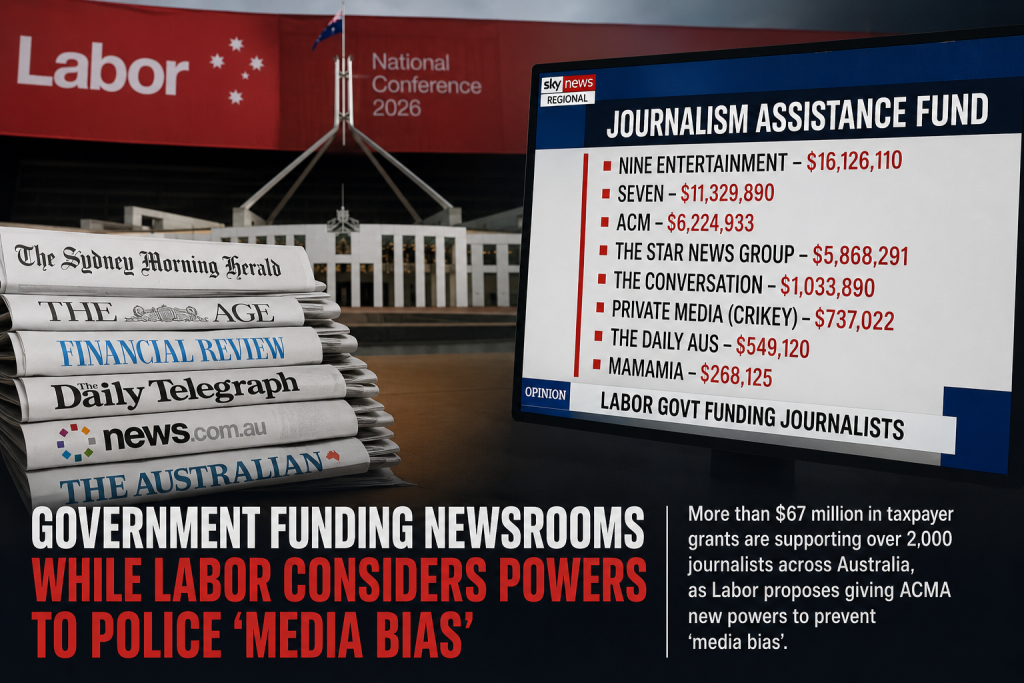
The Albanese Government is directing tens of millions of dollars into private news organisations as the Labor Party considers empowering ACMA to act against undefined “media bias”. Each policy may be defensible in isolation. Together, they raise questions about competition, editorial independence and the proper distance between government and the press.
The Australian Government is now subsidising the wages of more than 2,000 journalists employed by private news organisations—while the Australian Labor Party considers giving the national media regulator new powers to prevent “media bias”.
That conjunction deserves considerably more scrutiny than either policy has so far received.
Under the Commonwealth’s $67.6 million Journalism Assistance Fund, 185 successful applicants will receive taxpayer support over the three financial years ending in June 2028. The money is calculated principally by reference to journalistic employment: $13,000 annually for each eligible full-time-equivalent journalist, or $39,000 over the life of the program.
The Government says the scheme will preserve public-interest journalism, support digital news production and arrest the deterioration of a commercially disrupted industry. Those objectives are not frivolous. Regional newspapers have contracted, local reporting has disappeared from some communities and the business model that once financed journalism through classified advertising has been dismantled by digital platforms.
Yet the distribution figures reveal that the fund is not merely a narrowly targeted rescue package for fragile community publications.
According to the publicly disclosed allocations cited by Sky News, Nine Entertainment received $16,126,110; Seven received $11,329,890; Australian Community Media received $6,224,933; and the Star News Group received $5,868,291.
Together, those four groups account for approximately $39.55 million, or 58.5 per cent of the entire $67.6 million fund.
Nine’s reported allocation alone represents about 23.9 per cent of the fund. Seven accounts for another 16.8 per cent, Australian Community Media 9.2 per cent, and Star News Group 8.7 per cent.
The list extends well beyond the large commercial networks. The Conversation received $1,033,890, Private Media—the publisher of Crikey—received $737,022, The Daily Aus received $549,120 and Mamamia received $268,125. Other reported recipients include Capital Brief, The Saturday Paper and Michael West Media.
There is no evidence in the published material that these organisations were selected because of their editorial outlook. The fund was structured as an employment-based program available to qualifying publishers of digitally distributed core news. Nor should receiving a grant, by itself, be presented as proof that a newsroom has surrendered its independence.
Nevertheless, the result is that taxpayers are now contributing to the employment costs of news organisations across the editorial spectrum, including several publications generally associated with progressive or centre-left commentary.
That matters because the Government is not participating in the media market solely as a neutral source of financial assistance.
It is simultaneously developing a broader architecture of media subsidies, bargaining arrangements, regulatory reform and government-directed industry support.
A rapidly expanding system of media assistance
The Journalism Assistance Fund forms only one part of the News Media Assistance Program.
The Commonwealth says News MAP includes $99.1 million in grants for the news sector, alongside $33 million over three years for Australian Associated Press, a minimum Commonwealth commitment of $3 million annually for regional newspaper advertising, $10.5 million for the Australian Communications and Media Authority’s Media Diversity Measurement Framework, and the development of a National Media Literacy Strategy.
The Journalism Assistance Fund itself opened on 21 November 2025 and closed on 19 December—less than a month later—because it had become fully subscribed. The Government says its 185 grants support more than 2,000 journalists across 93 regional, 23 culturally and linguistically diverse, 22 suburban and two First Nations publishers.
A further $31.5 million News Innovation Fund has subsequently been offered, with individual grants ranging from $10,000 to $9 million. Eligible activities include increasing journalism production, expanding digital distribution, developing subscription and newsletter products, acquiring production equipment and improving publishers’ commercial capabilities.
The 2026–27 Budget also provides $15 million for AAP and $6.4 million to modernise media regulation and support structural changes in the market. It suspends the Commercial Broadcasting Tax for two years, at an estimated cost to revenue of $111.3 million over five years, and proposes a formula-based system for distributing money collected through the News Bargaining Incentive.
The Commonwealth is therefore becoming a substantial financier, rule-maker and market architect within Australian journalism.
That may reflect the depth of the industry’s economic difficulties. It also means the safeguards separating public support from political influence must be unusually strong—and visibly so.
The conference proposal that changes the context
The most consequential passage in Labor’s 2026 Draft National Platform appears under the reassuring heading “Healthy public debate”.
The platform promises a “strong, healthy, diverse and independent media operating in the public interest”. It supports continued public ownership of the ABC and SBS, community broadcasting, local news and free coverage of nationally significant events.
It then proposes something markedly more contentious:
“Labor will consider changes to regulation of media across all media to avoid bias and ensure the existing regulator ACMA has the appropriate tools to act to prevent media bias.”
The provision does not define bias. It does not identify the legal test ACMA would apply, the evidentiary threshold that would be required, the sanctions that might follow, or how legitimate editorial judgement would be distinguished from prohibited partiality.
Nor does the draft explain how a government regulator should determine bias without itself becoming an arbiter of acceptable political framing.
These omissions are not incidental.
Bias is not equivalent to factual error, unlawful vilification, undisclosed commercial influence or a failure to correct demonstrably false reporting. It can reside in story selection, prominence, language, choice of interviewees, contextual emphasis and the weight assigned to competing arguments. Reasonable people frequently disagree about whether such decisions constitute bias or merely editorial judgement.
A statutory power to “prevent media bias” could therefore reach significantly further than conventional broadcasting standards or rules requiring accuracy and fairness.
The proposal also appears to extend across “all media”, potentially taking regulation beyond traditional broadcasters and into newspapers, digital publishers, podcasts and other forms of online journalism.
That would represent a major alteration to Australia’s media settlement.
Funding does not purchase loyalty—but dependency can alter incentives
The strongest argument for the Journalism Assistance Fund is straightforward: journalism has characteristics of a public good, and the market no longer produces enough of it—particularly in regional and specialist fields.
There is considerable merit in that proposition. Courts, councils, parliaments and public agencies cannot be held accountable where no reporter is present. Small communities are not necessarily commercially capable of sustaining the journalism they need.
Public funding is not automatically inimical to independence. The ABC is publicly financed but operates under statutory arrangements intended to protect editorial autonomy. Several democracies support private news organisations through tax concessions, public-interest grants, postal assistance or arms-length media funds.
The problem is not the existence of assistance. It is the design of the relationship.
Direct wage subsidies reduce the employment costs of selected businesses while their unsubsidised competitors must finance the same work entirely through subscriptions, advertising, sponsorship or private capital.
For smaller publishers, $13,000 per journalist per year is material. A newsroom employing ten qualifying journalists can receive $130,000 annually. A competing publisher operating without the grant must either absorb that cost disadvantage or reduce its staffing, prices or investment.
The program can therefore influence market structure even where the Commonwealth exercises no editorial control.
Larger recipients also receive the greatest nominal benefits because the formula rewards the number of qualifying journalists already employed. That explains why major groups dominate the allocations, but it also creates a policy tension: a fund presented partly as a diversity measure has concentrated most of its money among a handful of established companies.
Scale has effectively generated subsidy.
The disclosure gap
A central weakness is the apparent absence of prominent, routine disclosure to audiences.
Grant recipients are publicly identifiable through the Commonwealth grants system, but readers should not be expected to search government databases to discover whether a publication receives taxpayer support.
A straightforward disclosure could accompany an outlet’s masthead, “about” page or editorial standards statement:
This publication receives support through the Australian Government’s Journalism Assistance Fund. The funding does not confer editorial control.
Such wording would not stigmatise recipients. It would enhance transparency and allow readers to assess possible institutional interests for themselves.
The principle is familiar. Journalists routinely expect political parties, lobby groups, research organisations and advocacy bodies to disclose financial relationships capable of creating a perceived conflict. Media organisations should not claim a lower standard for themselves.
Disclosure becomes particularly important when a funded publication reports on the government responsible for maintaining, replacing or expanding the program.
The issue is not necessarily actual interference. It is whether the structure creates a reasonable perception of dependency.
Were new entrants placed at a disadvantage?
The fund’s short application window also warrants examination.
Applications opened on 21 November and closed on 19 December 2025 because the scheme was fully subscribed.
A program exhausted within four weeks will naturally favour organisations with established administrative capacity, dedicated finance teams and immediate awareness of government grant processes. Smaller publishers, start-ups and journalist-led ventures may be less able to prepare an application at speed.
That risk is compounded by an employment-based formula. New entrants generally have fewer existing employees precisely because they lack the capital enjoyed by incumbent organisations. A mechanism based on current headcount can entrench existing market positions rather than produce new competition.
The separate News Innovation Fund may assist emerging operations, but grants of up to $9 million again raise questions about whether a small number of sophisticated applicants could secure a disproportionate share.
A genuinely pro-diversity model would reserve meaningful funding for new entrants, underserved markets and publishers below specified revenue or staffing thresholds.
A question of ideological balance
It would be misleading to portray the Journalism Assistance Fund as exclusively financing centre-left media.
The largest recipients are major commercial organisations with varied editorial products, and the broader list encompasses regional, suburban, multicultural and specialist outlets. The allocation methodology appears to have been based primarily on eligibility and journalist numbers, not an assessment of political orientation.
Even so, public concern will understandably arise when strongly opinionated publications receive government support while the governing party proposes regulatory action against “bias”.
The answer is not for Canberra to classify publishers as left, right or centrist and allocate money according to a contrived ideological quota. That would make the state’s involvement more—not less—political.
The answer is to maintain viewpoint neutrality, publish complete assessment information, disclose funding clearly, separate ministers from decisions and confine regulation to objectively defined harms.
The Government should also disclose:
- every applicant, including unsuccessful applicants where legally permissible;
- the number of eligible journalists claimed by each recipient;
- the methodology used to aggregate related corporate entities;
- the total public support each ownership group receives across all media programs;
- any compliance findings or repayments;
- the measures used to assess whether funded positions were genuinely preserved; and
- whether recipients must notify readers of Commonwealth support.
Without those details, the public can see who received money but cannot fully evaluate how the scheme altered the market.
What safeguards are required?
At a minimum, Australia needs a clear firewall between media assistance and media regulation.
Funding decisions should be administered by an independent statutory body or genuinely arms-length panel operating under published, viewpoint-neutral criteria. Ministers should neither select recipients nor possess discretion to reward or penalise particular editorial organisations.
Future assistance should contain stronger concentration limits. A diversity program should not permit most funding to accumulate among several ownership groups unless the Government can demonstrate that this is indispensable to the scheme’s public-interest purpose.
Recipient disclosure should be mandatory and easily visible.
Most importantly, Labor should abandon—or substantially rewrite—the proposal empowering ACMA to act against “media bias”.
Regulators can enforce accuracy obligations, ownership rules, classification standards, advertising requirements and protections against specified harms. They should not be commissioned to determine which political narratives are sufficiently balanced.
An undefined prohibition on bias is especially problematic where the state is simultaneously subsidising many of the organisations it may later regulate.
The democratic danger lies in the combination
There is a respectable case for public assistance to journalism. There is also a respectable case for modernising regulation in response to technological convergence and the declining distinction between broadcasting, publishing and social media.
But policy cannot be assessed only in isolated compartments.
A government that finances private newsrooms, distributes media-industry revenue, purchases advertising, funds public broadcasters and appoints the regulator already occupies a powerful position within the information ecosystem.
If the governing party then proposes that the regulator be empowered to decide and prevent “bias”, the cumulative effect becomes constitutionally and democratically significant.
The threat is not necessarily that journalists will be instructed what to write. Influence is rarely so crude.
The more plausible danger is gradual institutional dependence: publishers structure their operations around public money; future funding becomes part of commercial planning; regulatory exposure increases; and the distance between government and those reporting upon it quietly narrows.
A free press must be economically viable. It must also remain capable of scrutinising government without seeking its approval, fearing its definition of bias or depending upon its continuing financial favour.
Labor’s conference delegates should recognise that the credibility of public-interest journalism depends not merely on keeping newsrooms open, but on ensuring the state cannot become simultaneously their benefactor, regulator and judge.