
The Prime Minister Made a Serious Error of Judgment by Allowing the Office to Be Diminished
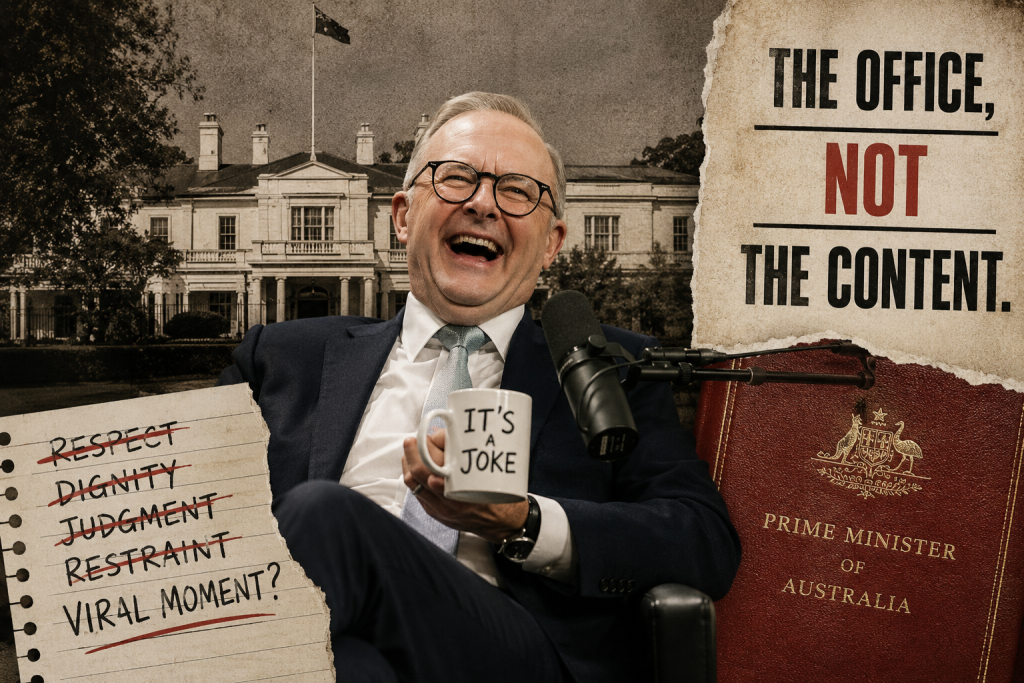
Every Prime Minister makes decisions that define not only their government but also the institution they temporarily occupy.
Anthony Albanese’s decision to invite a popular comedy podcaster into The Lodge for a free-flowing interview filled with profanity, sexual innuendo and juvenile humour was one of those decisions.
It was a serious error of judgment.
This is not a criticism of the podcast host. She produces entertainment for her audience and did exactly what his audience expects. Nor is it an argument that politicians should isolate themselves from modern media or refuse to engage with younger Australians.
The failure lies elsewhere.
It lies with the Prime Minister’s willingness to allow Australia’s highest elected office to become part of that entertainment.
Throughout the interview, Albanese willingly engaged in jokes about his marriage, laughed through repeated sexual references, endorsed a mock campaign slogan containing profanity, joked about drinking and participated in exchanges that would once have been unimaginable from inside Australia’s official prime ministerial residence.
None of this happened by accident.
Every minute of the interview required a conscious decision by the Prime Minister to continue participating.
Every joke that crossed the line into the crude presented an opportunity to redirect the conversation.
Every exchange that diminished the dignity of the setting could have been avoided.
Instead, the Prime Minister chose to lean into it.
That is why the responsibility ultimately rests with him.
The Lodge is not simply Anthony Albanese’s home.
It belongs to the Australian people.
It is one of the nation’s principal official residences—a place where presidents, prime ministers, monarchs, governors-general and military leaders are welcomed. It represents continuity of government and the authority of the Commonwealth itself.
That symbolism carries obligations.
Every occupant of The Lodge inherits a responsibility not merely to exercise executive power, but to preserve the dignity of the office for those who follow.
Prime ministers come and go.
The institution remains.
That is precisely why Australians expect those entrusted with the office to distinguish between being relatable and becoming part of a comedy routine.
Politics has changed dramatically in recent years. Podcasts, influencers and online personalities now reach audiences that rival traditional media. There is nothing wrong with governments engaging through these channels.
Indeed, they should.
But there remains an important distinction between communicating through modern platforms and allowing the office of Prime Minister to become another source of online content.
That distinction appeared to disappear throughout this interview.
Supporters will argue that Albanese looked authentic, relaxed and approachable. Perhaps he did.
However, authenticity is not the only quality expected of a Prime Minister.
Judgment matters.
So does restraint.
So does an appreciation that some institutions deserve to stand above the daily contest for clicks, views and viral moments.
Good leaders understand that not every opportunity should be accepted simply because it promises publicity.
The best leaders recognise that the office they hold is larger than their own personal brand.
That is why this interview represents, a significant lapse in judgment.
The concern is not that Anthony Albanese appeared on a podcast.
It is that he appeared willing to allow the dignity of Australia’s highest elected office to be subordinated to entertainment.
Future prime ministers of every political persuasion should reflect on that lesson.
Once respect for an institution is diminished, restoring it is considerably more difficult than preserving it in the first place.