
Barney Glover sets out vision for higher education overhaul as new tertiary commission begins work
By Michael Keating | Inside Canberra
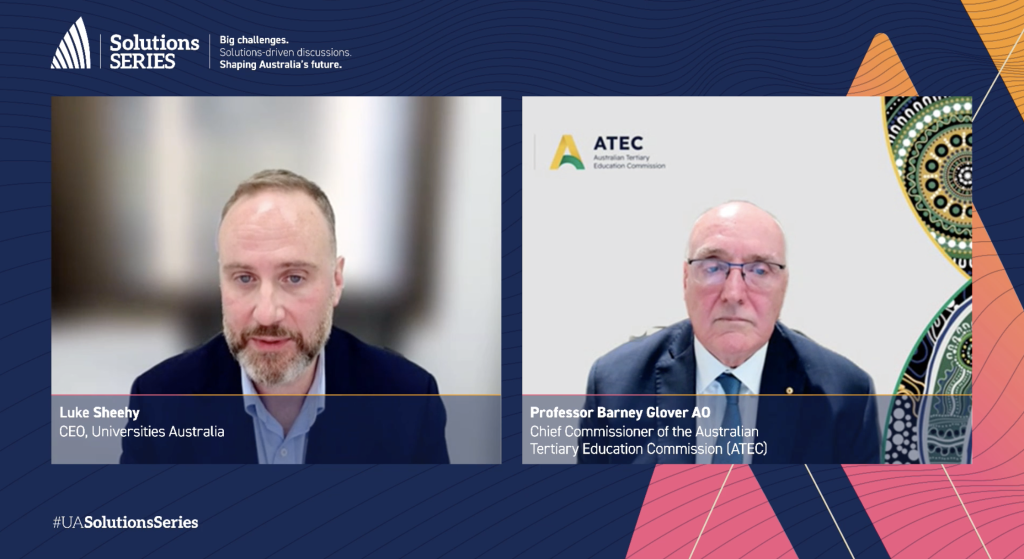
Australia’s most significant higher education reform in decades is now underway, with the newly established Australian Tertiary Education Commission (ATEC) promising to reshape the relationship between government, universities and vocational education through what its inaugural Chief Commissioner, Professor Barney Glover AO, repeatedly described as a model of “stewardship rather than control.”
Speaking in his first major public appearance since formally taking office on 1 July, Professor Glover joined Universities Australia CEO Luke Sheehy for an hour-long discussion that attracted more than 1,260 participants—a record audience for the organisation’s Solutions Series.
The conversation offered the clearest indication yet of how the commission intends to implement the Universities Accord and manage Australia’s tertiary education system over coming decades.
For Canberra policymakers, university leaders and researchers, it also answered one of the biggest outstanding questions: what exactly will ATEC become?
A new institution designed to outlast election cycles
At the centre of Professor Glover’s message was the argument that Australia’s tertiary education system has suffered from decades of short-term policymaking.
Rather than acting as another regulator, he described ATEC as an independent steward responsible for taking a longer-term view of national workforce needs, university planning and research capability.
While acknowledging concerns within the sector that the commission could become overly interventionist, Glover stressed repeatedly that ATEC’s role would be collaborative.
“We’re not here to direct the system. We’re here to work with universities… through negotiation, engagement, facilitation and collaboration.”
That distinction was one of the defining themes of the webinar.
ATEC will oversee the new mission-based compact process, negotiate future student allocations and provide annual assessments of the health of Australia’s tertiary education system while operating independently of day-to-day government decision-making.
Independence was a recurring theme
Universities have long argued that higher education policy has become too vulnerable to political cycles.
Professor Glover argued that the new statutory model gives ATEC genuine independence.
He pointed to the commission’s legal status, independent commissioners and the memorandum of understanding signed with the Department of Education in the commission’s first week as practical safeguards against political interference.
“The proof,” he acknowledged, “will ultimately be in demonstrating that independence.”
Transparency, regular communication with universities and publication of commission decisions will form part of building confidence across the sector.
Managed growth—not managed decline
Perhaps the biggest policy shift outlined during the discussion was the move away from Australia’s partially demand-driven university funding model.
Rather than allowing unlimited enrolments without corresponding Commonwealth support, Professor Glover argued that Australia now requires managed growth tied to national priorities.
His objective is ambitious.
ATEC is working towards the Universities Accord target that 80 per cent of working-age Australians hold a tertiary qualification by 2050.
Achieving that, he argued, will require:
- substantially increasing university participation;
- lifting enrolments among disadvantaged Australians;
- improving First Nations participation;
- ending the growth of marginally funded university places; and
- creating a far closer relationship between universities and vocational education.
Importantly, Glover emphasised that ATEC allocates student places rather than funding, with Commonwealth funding following those allocations.
Mission-based compacts become the centrepiece
The discussion also provided the clearest explanation yet of how mission-based compacts will operate.
Rather than becoming simple funding agreements, Professor Glover said they are intended to recognise each university’s unique mission while aligning institutional objectives with broader national priorities.
Australia’s universities, he argued, are not homogeneous institutions.
Instead, regional universities, metropolitan universities and research-intensive institutions each perform different roles that should be recognised rather than standardised.
The commission hopes four-year compact negotiations—guided by regularly updated Statements of Strategic Priorities—will provide something universities have repeatedly requested over recent years:
stability.
That stability is intended to replace the policy volatility created by repeated funding reforms, international student caps and changing government priorities.
Funding reform remains unfinished
One of the webinar’s strongest policy discussions centred on the future of the Job-ready Graduates package.
While many universities hope for rapid reform of student contribution arrangements, Professor Glover cautioned against simplistic solutions.
Rather than merely shifting costs between different groups of students, he argued that ATEC intends to undertake a comprehensive review of university costing and pricing before making recommendations during the second half of 2027.
His comments suggest substantial structural reform rather than incremental changes.
“It needs to be considered holistically,” he said, warning against simply redistributing student debt without addressing the underlying funding model.
Research also moves into focus
Although much attention has centred on teaching funding, Professor Glover confirmed ATEC intends to become increasingly involved in Australia’s research system.
The commission has already incorporated research training into its mission-based compact negotiations while awaiting the Commonwealth’s response to the Strategic Examination of Research and Development (SERD).
Research workforce shortages, doctoral training, stipends and postdoctoral career pathways are all expected to become part of ATEC’s longer-term work program.
Better data, better planning
Professor Glover also identified data quality as one of the commission’s major priorities.
Rather than necessarily becoming the custodian of university data itself, ATEC wants access to more timely and comprehensive information to better understand enrolment trends, equity participation and future workforce needs.
He argued that improved data would be essential for creating smoother pathways between TAFE and university while helping disadvantaged students navigate Australia’s increasingly complex tertiary education system.
Inside Canberra’s question: What does success actually look like?
The webinar concluded with a question submitted by Inside Canberra, asking Professor Glover to define what success would look like for ATEC five years from now.
Rather than identifying a single performance measure, Professor Glover outlined a broader vision built around several interconnected outcomes.
Success, he said, would mean a tertiary education system characterised by stability, sustainability and consistency.
It would include:
- dramatically increased participation in tertiary education;
- significant growth in equity student enrolments;
- stronger collaboration between universities and TAFE;
- seamless pathways across the tertiary sector;
- improved research outcomes;
- greater innovation and entrepreneurship; and
- a university system better equipped for an AI-driven economy.
Perhaps his most revealing remark came near the conclusion.
Professor Glover said he wanted to “unshackle the system” so universities could concentrate on what they do best rather than continually adapting to policy uncertainty.
It was a fitting summary of the philosophy underpinning Australia’s largest higher education reform in a generation.
If ATEC succeeds, Professor Glover suggested, universities should become less consumed by administrative uncertainty and more focused on teaching, research, innovation and preparing Australians for the rapidly changing economy ahead.
Analysis
The webinar highlighted that ATEC is being positioned as far more than another funding body. Its remit extends from allocating Commonwealth-supported places to shaping long-term strategy, improving data, fostering collaboration across universities and TAFE, and providing independent advice to government.
For a sector that has endured years of shifting funding models, international student policy changes and repeated structural reviews, Professor Glover’s emphasis on predictability over disruption may prove to be one of the commission’s most significant promises.
Whether that ambition can be realised will become clearer as the first mission-based compact negotiations conclude over coming months. But if Wednesday’s discussion is any indication, ATEC intends to redefine not only how Australia’s universities are funded, but how the entire tertiary education system is planned for decades to come.