
Albanese centralises AI policy and sets course for mandatory national standards
The Prime Minister has placed artificial intelligence at the centre of government, announcing a new Office of AI and a national framework spanning data centres, copyright, energy, employment and sovereign capability.
Prime Minister Anthony Albanese has moved to consolidate the Commonwealth’s fragmented approach to artificial intelligence, declaring that Australia must become a maker of AI technology—not merely a consumer of systems developed overseas.
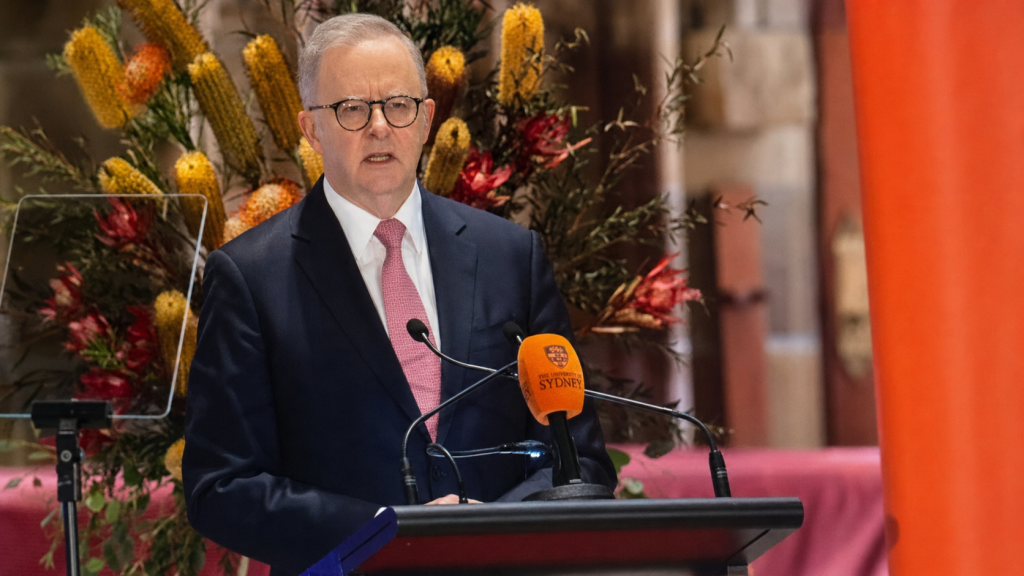
In a major address at the University of Sydney on Wednesday, Mr Albanese announced the immediate establishment of an Office of AI within the Department of the Prime Minister and Cabinet. The office will coordinate policy across government and oversee the development of new Australian standards for the rapidly evolving technology.
The Prime Minister will seek agreement from premiers and chief ministers at National Cabinet next month, with the government aiming to introduce legislation and secure its passage early in 2027.
“It is not a question of if or when AI will transform our economy; we’re past that,” Mr Albanese said. “The question that matters, the choice that we have, is how.”
The announcement elevates AI from a collection of sector-specific initiatives to a whole-of-government economic and strategic project. It also brings responsibility closer to the Prime Minister, with the new office expected to coordinate work already occurring across industry, employment, education, communications, defence, home affairs, energy and the Attorney-General’s portfolio.
The Office of AI has not, however, been described as an independent regulator. Its initial function will be coordination and policy design, leaving its staffing, statutory powers and relationship with bodies including the National AI Centre and the planned Australian AI Safety Institute to be determined.
National rules for the infrastructure behind AI
The first concrete regulatory task will involve converting the government’s existing expectations for large data centres into a “clear, consistent and mandatory” national framework.
The government’s data centre expectations, published in March, currently call upon developers to contribute to Australia’s national interest, support the energy transition, minimise water consumption, invest in Australian skills and strengthen domestic technological capability.
Under the approach outlined by Mr Albanese, the next generation of large-scale facilities would be legally required to underwrite additional electricity supply, meet their full share of grid-connection costs and contribute at least as much power to the electricity system as they consume.
The Prime Minister said operators would be expected to fund new renewable generation and firming capacity, ensuring that data centres became “net generators, not net users” and did not impose higher electricity costs on households or other businesses.
Developers would also be required to minimise water consumption, improve energy efficiency and pay for any additional water infrastructure their projects required.
The scale of prospective demand explains the government’s urgency. Research prepared for the Australian Energy Market Operator estimates Australian data centres consumed 3.9 terawatt hours of electricity in 2024–25, equivalent to approximately two per cent of electricity supplied through the National Electricity Market.
Under AEMO’s central scenario, consumption is forecast to reach 12 terawatt hours by 2029–30, representing about six per cent of NEM electricity supply. The research identifies AI adoption and digital transformation as major drivers of that growth.
In exchange for more demanding obligations, the Commonwealth is offering investors nationally consistent requirements, faster decision-making and a streamlined process for securing and verifying approvals.
This amounts to an attempt to establish a national bargain: Australia will welcome substantial international investment, but not without corresponding investment in electricity, water, skills and domestic capability.
Important questions remain unanswered, including which facilities will qualify as “large-scale”, how additional renewable generation will be measured, what enforcement provisions will apply and how Commonwealth standards will intersect with state planning and environmental laws.
Copyright placed at the centre of the framework
Mr Albanese also adopted an unequivocal position on the use of Australian creative works to train commercial AI systems.
“Not everything produced in Australia is up for grabs,” he said.
The Prime Minister declared that Australian writers, musicians, artists and journalists must retain ownership and control of their work—including control over its price—and said the law would reflect that principle.
“No company should use Australian books, music, art or news to build or train AI without the artist’s control,” he said. “Anything less is theft.”
The statement reinforces the government’s previous rejection of a broad text-and-data-mining exception, which could have allowed AI developers to use copyright material without first obtaining permission.
The Attorney-General’s portfolio is presently examining whether Australia should retain voluntary licensing arrangements or establish a paid collective licensing framework. It is also considering less expensive enforcement mechanisms for creators pursuing smaller copyright claims. The government ruled out a broad text-and-data-mining exception in October 2025.
The speech settles the government’s political principle more clearly than its legal mechanism. Designing a workable system for identifying training material, calculating compensation and enforcing Australian rights against overseas developers will be considerably more complex.
Ambition extends beyond hosting foreign data
The broader economic argument advanced by the Prime Minister was that Australia should not become simply a “data warehouse” for AI products designed and controlled elsewhere.
Instead, the government wants universities, Australian companies and international firms to develop technology domestically, particularly in cybersecurity, biotechnology, defence and advanced manufacturing.
Mr Albanese linked this ambition to the government’s Future Made in Australia agenda, presenting technological sovereignty as another component of national resilience.
“If we are always dependent on someone else, somewhere else, we will always be vulnerable,” he said.
Artificial intelligence is already spreading through the economy. Australian Bureau of Statistics data shows approximately 12 per cent of Australian businesses used AI during 2024–25. Adoption reached 35 per cent among large businesses but remained at about 11 per cent among small and micro businesses.
That uneven uptake illustrates both the opportunity and the risk confronting policymakers: the productivity gains may be substantial, but they may not be distributed evenly between businesses, industries or workers.
Employment evidence remains qualified
The Prime Minister argued that AI should be used to create secure employment rather than treated principally as a threat to jobs.
He cited new research from the Department of Employment and Workplace Relations showing no evidence of broad AI-driven upheaval in the Australian labour market. Graduate employment remains comparatively strong, occupational movement has not accelerated and aggregate labour-market conditions remain resilient.
The report’s findings are nonetheless more qualified than a straightforward assurance that jobs are unaffected.
Between November 2022 and February 2026, employment in the fifth of occupations most exposed to generative AI grew by 5.6 per cent, compared with 9.5 per cent among the least-exposed occupations. Its statistical model also identified a small negative relationship between AI exposure and employment growth, although the result changed under alternative modelling assumptions.
The department consequently described the evidence as an early signal warranting continued monitoring—not proof that AI has caused widespread job losses. The report also cautions that it does not measure wages, productivity, job quality or workplace surveillance.
Political scrutiny turns to delivery
Opposition Leader Angus Taylor dismissed the new administrative structure as “an office in an office” and argued that the government should concentrate on the technology’s capacity to improve productivity, wages and living standards.
That criticism foreshadows the central political contest surrounding the announcement: whether greater coordination from the Prime Minister’s department produces coherent national policy or merely another layer of bureaucracy.
The government’s task will also be to demonstrate that faster approvals do not dilute environmental scrutiny, that infrastructure commitments are genuinely additional and that investment produces lasting Australian capability rather than a temporary construction boom.
Mr Albanese has now assumed direct political ownership of the issue. The Office of AI and the proposed national standards establish the machinery, but the legislation will reveal its authority and practical reach.
Australia’s AI policy has entered a new phase. The question is no longer whether the Federal Government intends to intervene, but whether it can reconcile foreign investment, sovereign capability, creative ownership, environmental limits and employment security within a framework capable of keeping pace with the technology itself.