
ACT Federal Electoral Boundaries Finalised: Woden Unified in Bean as AEC Confirms Redistribution
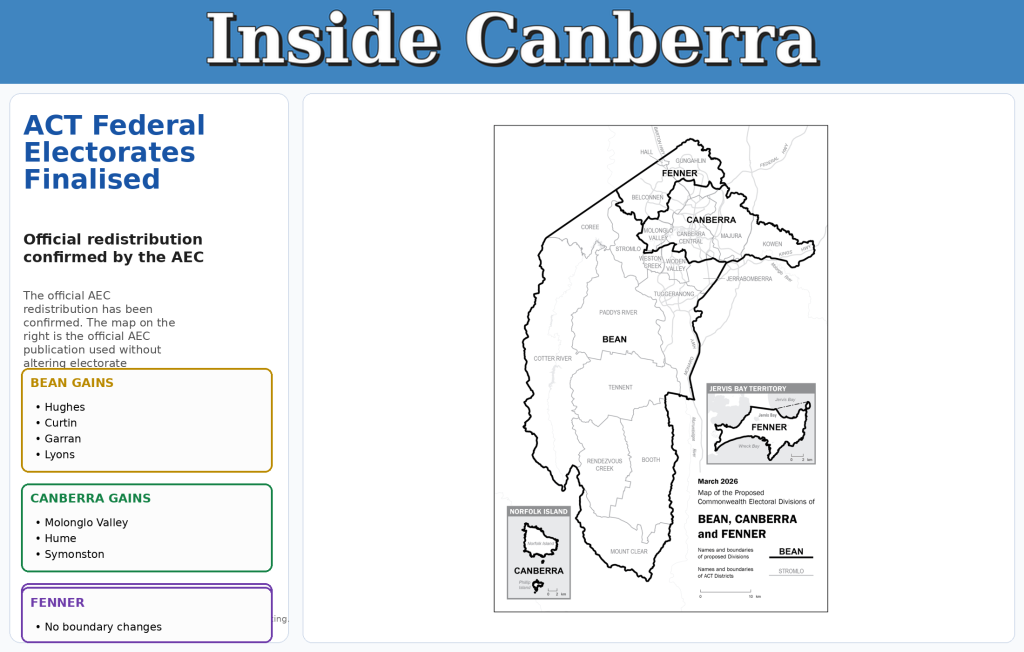
The Australian Electoral Commission (AEC) has confirmed the final federal electoral boundaries for the Australian Capital Territory, locking in a series of changes that will reshape representation at the next federal election while leaving one of the Territory’s most debated proposals on the cutting room floor.
After months of consultation and public submissions, the AEC has largely endorsed a revised redistribution that sees parts of Canberra’s south move into the electorate of Bean and sections of the Territory’s rapidly growing western and eastern suburbs transferred into Canberra. The changes will first apply at the next federal election, due by May 2028.
What changes?
Under the final determination:
- Hughes, Curtin, Garran and Lyons will transfer from the electorate of Canberra to Bean.
- Molonglo Valley, along with Hume and Symonston, will move from Bean into Canberra.
- Fenner remains unchanged, despite earlier proposals that would have significantly altered its southern boundary.
Perhaps the most significant practical consequence is that the entire Woden Valley will now sit within a single federal electorate, Bean, ending years in which the community was divided between two House of Representatives seats.
For residents, this means a single federal member will represent the whole of Woden on issues ranging from transport and planning to health services and local infrastructure.
A victory for community submissions
The final outcome differs materially from the draft boundaries released in March.
The original proposal would have:
- shifted Crace, Kenny and Mitchell from Fenner into Canberra;
- transferred Weetangera, Hawker and Macquarie from Canberra into Fenner;
- moved Norfolk Island and part of Duffy from Bean into Canberra.
None of those changes survived the consultation process.
Instead, the augmented Electoral Commission concluded that the alternative arrangements better reflected established communities of interest after considering submissions from political parties, organisations and individual residents.
Electoral Commissioner Jeff Pope said public participation had materially influenced the final decision.
“The changes made to the original proposal published in March were a result of public input, including how electorate boundaries could best reflect local communities.”
That outcome serves as a reminder that Australia’s independent redistribution process is not simply a technical exercise. Unlike many overseas jurisdictions where governments or legislatures draw electoral boundaries, Australia’s redistributions are conducted independently under the Commonwealth Electoral Act, with extensive opportunities for public submissions before final decisions are made.
Why the redistribution was required
The ACT redistribution was not triggered by political considerations.
Federal law requires redistributions at least every seven years, or sooner if enrolment numbers move outside allowable limits. The Territory’s previous redistribution occurred in 2018 following the creation of the electorate of Bean, making a fresh review necessary in 2025–26.
Throughout the process, the AEC was required to balance several competing objectives, including:
- keeping elector numbers within legal quotas;
- recognising existing communities of interest;
- considering transport links and communication networks;
- accounting for projected population growth.
Rapid development across Molonglo Valley, Belconnen and Canberra’s southern suburbs featured prominently in the Commission’s analysis.
Political implications
While redistributions are conducted independently and are not intended to advantage any political party, boundary adjustments inevitably have electoral consequences.
The transfer of established inner-south suburbs into Bean and the movement of Molonglo Valley into Canberra subtly reshapes the demographic composition of both electorates. Political parties will now begin analysing the revised enrolment data and recalculating notional margins ahead of the 2028 federal election.
Fenner’s unchanged boundaries may also come as a relief to residents and political stakeholders after considerable debate over the earlier proposal.
What happens next?
Although the boundaries have now been determined, detailed electoral maps will be formally released when the redistribution process is completed, with the final report later tabled in Parliament.
For ACT voters, there is no immediate change. Existing federal electorates remain in place until the next House of Representatives election.
However, residents in the affected suburbs should expect to vote in a different electorate at that election and may find themselves represented by a different federal MP without having moved house.
With the redistribution now settled, Canberra’s political focus shifts from where the lines are drawn to how parties position themselves within those newly configured electorates ahead of what is shaping as another closely watched federal contest.