Defence’s 184-Page Blueprint: Can Australia Actually Build the Military Industrial Base It Says It Needs?
By Michael Keating | Inside Canberra
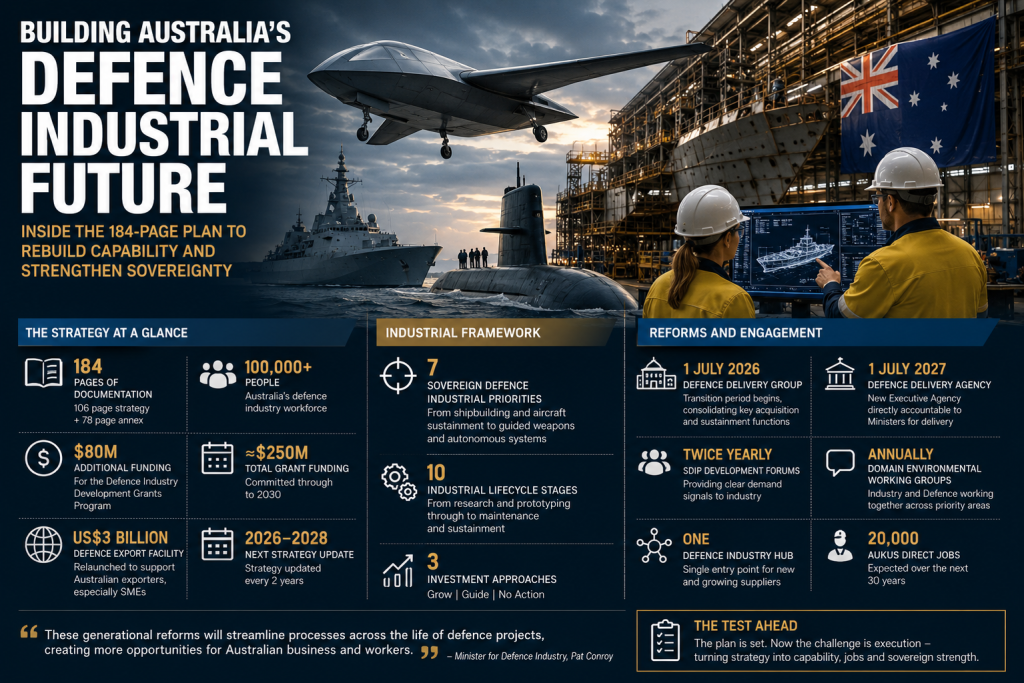
Australia has released what is arguably its most detailed defence industry blueprint ever produced.
Spread across 184 pages—a 106-page Defence Industry Development Strategy, a 78-page technical annex, and supporting fact sheets—the documents represent a fundamental rethink of how Australia intends to design, build, maintain and export military capability over the coming decade.
Government messaging centres on “sovereign capability”, “greater self-reliance” and “stronger partnerships”. But buried beneath the political language is a far more revealing story.
The documents amount to an admission that Australia’s defence procurement system has been too slow, industrial capacity too shallow, supply chains too vulnerable and industry engagement too fragmented for an increasingly unstable strategic environment.
The challenge is no longer identifying what Australia needs.
The challenge is whether Australia can actually build it before it is needed.
The strategy by the numbers
The sheer scale of the strategy is worth understanding before examining its contents.
| Measure | Figure |
|---|---|
| Main Defence Industry Development Strategy | 106 pages |
| Technical Sovereign Industrial Priorities Annex | 78 pages |
| Total documentation | 184 pages |
| Defence industry workforce | 100,000+ people |
| Additional Defence Industry Development Grants | $80 million |
| Total Grant Program funding to 2030 | Approximately $250 million |
| Defence Export Facility | US$3 billion |
| Defence Delivery Agency commences | 1 July 2027 |
| Defence Delivery Group begins | 1 July 2026 |
| Sovereign Defence Industrial Priorities | 7 |
| Industrial capability lifecycle stages | 10 |
| Strategy review cycle | Every 2 years |
| Environmental Working Groups | At least annually |
| SDIP Development Forums | Twice yearly |
| Expected AUKUS direct workforce | 20,000 jobs over 30 years |
Those numbers tell a story of their own.
A modest funding increase against enormous ambition
The financial headline is straightforward.
The Government will inject an additional $80 million into the Defence Industry Development Grants Program, lifting total funding to around $250 million through 2030.
On paper, that sounds significant.
But measured against Defence’s ambitions, the investment appears comparatively modest.
The strategy expects Australian industry to expand capability across seven major industrial priorities simultaneously:
- Aircraft maintenance, repair, overhaul and upgrades;
- Continuous naval shipbuilding and sustainment;
- Combined-arms land systems;
- Domestic guided weapons and munitions manufacturing;
- Autonomous systems;
- Battlespace awareness and management systems;
- Test, evaluation and systems assurance.
Spread evenly, the additional funding equates to around $11.4 million per industrial priority, while the total grant pool represents roughly $35.7 million per priority area through to 2030.
That is unlikely to transform Australia’s industrial base on its own.
Instead, the grants appear intended to help companies mature, obtain Defence security accreditation, commercialise technology and scale operations rather than directly finance major manufacturing expansion.
Defence quietly admits procurement has become too slow
Perhaps the most important reform receives relatively little public attention.
On 1 July 2026, Defence established the Defence Delivery Group, merging Capability Acquisition and Sustainment, Guided Weapons and Explosive Ordnance, and Naval Shipbuilding and Sustainment into a single transition organisation. That transition culminates on 1 July 2027 with the creation of the Defence Delivery Agency, an Executive Agency led by the National Armaments Director and directly accountable to ministers for acquisition and sustainment performance.
The strategy is unusually candid about why the reform is necessary.
It states the reforms address “a capability system that has not kept pace with Australia’s deteriorating strategic environment”.
In other words, Defence acknowledges the existing procurement model has become too slow.
The solution centres on:
- Continuous Capability Development and Delivery (C2D2);
- minimum viable contracting;
- earlier industry engagement;
- stronger demand signals;
- greater acceptance of developmental risk; and
- continuous capability upgrades rather than decade-long acquisition cycles.
If successful, the reforms could significantly shorten acquisition timelines.
If not, Australia risks simply replacing one bureaucracy with another.
From policy statements to engineering specifications
One of the biggest changes from the 2024 strategy is the level of technical detail.
Rather than simply identifying seven industrial priorities, the annex maps capability across a 10-stage industrial lifecycle:
- Research
- Technological prototyping
- Development and industrialisation
- Adaptation
- Manufacturing
- Assembly
- Integration and commissioning
- Operational support
- Fault diagnosis and repair
- Maintenance
Innovation is expected across every stage of the lifecycle.
That framework gives companies far clearer guidance about where Defence intends to invest—and, equally importantly, where it does not.
Autonomous systems move to centre stage
The strategy confirms autonomous systems are no longer viewed simply as drones.
The technical annex breaks sovereign capability into dozens of industrial components, including:
- propulsion systems;
- batteries and energy storage;
- navigation systems;
- secure communications;
- payload integration;
- autonomy software;
- command and control;
- sensors;
- manufacturing capability;
- systems engineering.
Similarly, battlespace awareness spans everything from cloud computing and data centres to optical communications, satellite links, cyber security, electromagnetic warfare, AI-enabled sensor fusion and advanced networking technologies.
This is far more sophisticated than previous industrial planning documents.
Sovereignty still depends on allies
Despite repeated references to sovereign capability, the documents stop well short of promising complete self-sufficiency.
Instead, Defence repeatedly emphasises cooperation with trusted international partners, resilient global supply chains and export growth.
That reflects industrial reality.
Australia simply cannot economically manufacture every defence capability domestically.
Instead, sovereignty increasingly means maintaining domestic capability in those areas most critical to operational readiness while relying on allied industrial ecosystems elsewhere.
Ghost Shark emerges as Australia’s flagship export
Among the clearest signals is Defence’s decision to prioritise the Ghost Shark Extra Large Autonomous Underwater Vehicle for export support through the Australian Defence Strategic Sales Office.
The strategy also relaunches the US$3 billion Defence Export Facility, with greater emphasis on helping Australian SMEs enter international markets.
Export policy is increasingly becoming industrial policy.
Larger export orders help manufacturers lower costs, maintain production lines and sustain the workforce required for Defence capability during times of crisis.
The workforce challenge may prove the hardest
The strategy acknowledges Australia’s defence industry already employs more than 100,000 people.
Yet AUKUS alone is expected to create around 20,000 direct jobs over the next 30 years.
That implies workforce demand equivalent to around 20 per cent of today’s defence industry before accounting for:
- guided weapons production;
- continuous shipbuilding;
- autonomous systems;
- cyber capability;
- advanced manufacturing;
- aircraft sustainment.
To address the shortfall, Defence proposes:
- apprenticeship targets with defence primes;
- expanded STEM engagement;
- Defence Industry Workforce Plans;
- Defence Research Network partnerships;
- state and territory workforce planning forums;
- university and vocational pathways;
- APS professionalisation; and
- Defence Learning Academy programs.
However, engineers, software developers, welders, systems integrators, machinists and technicians cannot simply be created by policy.
Training them takes years.
More forums—or better decisions?
Industry has long complained about inconsistent engagement.
The response is extensive.
The strategy creates:
- annual Domain Environmental Working Groups;
- biannual Sovereign Defence Industrial Priority Development Forums;
- state and territory coordination forums;
- Industry Associations Advocacy Group roundtables;
- a Defence Research Network;
- expanded classified engagement;
- the Defence Industry Hub as a single entry point for new suppliers.
Collectively, the framework is designed to replace ad hoc engagement with continuous dialogue.
Whether it accelerates decision-making or simply generates more meetings remains to be seen.
The verdict
The 2026 Defence Industry Development Strategy is undeniably more detailed than its predecessor.
It provides industry with clearer demand signals, maps capability down to engineering disciplines, reforms procurement, expands export support and attempts to rebuild Australia’s industrial resilience.
Yet none of those achievements manufacture a missile.
None launch an autonomous submarine.
None build a frigate.
None train an engineer.
For all its detail, the strategy remains a blueprint.
Its success will ultimately be measured not by the quality of its 184 pages, but by whether Australian factories expand production, skilled workers enter the sector, procurement accelerates and capability reaches the Australian Defence Force before—not after—it is required.
That is the standard against which this strategy, and the Government’s broader defence industrial agenda, will ultimately be judged.