
WHO REALLY WINS from a bigger Parliament?
The proposal to expand Australia’s federal Parliament is often framed as a political choice. In practice, it is more accurately understood as a response to measurable structural pressures within the electoral system.
This analysis examines:
- Population and representation trends
- The numerical structure of the proposed expansion
- Electoral outcomes based on 2025 data
- The specific implications for the Australian Capital Territory
1. Representation Ratios: The Structural Driver
Australia’s Parliament currently consists of:
- 150 Members of the House of Representatives
- 76 Senators
The last major expansion occurred in 1984, when Australia’s population was approximately 16 million.
As of 2025:
- Australia’s population exceeds 27 million
This implies:
- Population growth of approximately +70% since the last expansion
However:
- The House has increased only modestly over that period
- The Senate structure has remained largely unchanged
Current Representation Ratio
- ~120,000–130,000 constituents per MP (derived from population divided by 150 seats)
By comparison, many OECD democracies maintain lower voter-to-representative ratios, indicating that Australia operates with relatively larger electorates.
2. Proposed Expansion: Numerical Parameters
The most widely referenced expansion model includes:
House of Representatives
- Increase from 150 → ~174–175 seats
- Net addition: +24 seats
Senate
- Increase from 76 → ~90+ Senators
- Net addition: +14 to +16 Senators
Territories
- ACT: 2 → 4 Senators
- NT: 2 → 4 Senators
Cost Estimate
- Approximately $600 million (Parliamentary Budget Office modelling cited at press conference)
3. House Expansion: Distribution Based on 2025 Results
2025 Federal Election Outcome (House of Representatives)
- Labor: 94 seats
- Coalition: 43 seats
- Crossbench and others: remainder
These figures establish the baseline from which additional seats would be distributed.
Projected Allocation of +24 Seats
Based on:
- Population growth distribution
- 2025 voting patterns
- Electoral geography
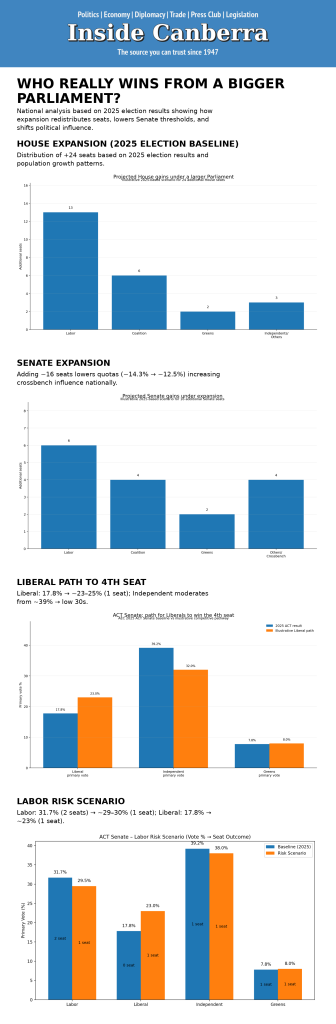
The illustrative allocation used in the charts is:
| Group | Additional Seats |
|---|---|
| Labor | 13 |
| Coalition | 6 |
| Greens | 2 |
| Independents/others | 3 |
Interpretation
- Labor receives approximately 54% of additional seats (13/24)
- Coalition receives approximately 25% (6/24)
- Minor parties and independents collectively receive approximately 21% (5/24)
This reflects the concentration of population growth in Labor-leaning electorates.
4. Senate Expansion: Quota and Distribution Effects
Current Senate Composition (48th Parliament)
- Labor: 29 seats
- Coalition: 27 seats
- Greens: 10 seats
- Crossbench: 10 seats
Projected Additional Seats (+16 Scenario)
| Group | Additional Seats |
|---|---|
| Labor | 6 |
| Coalition | 4 |
| Greens | 2 |
| Crossbench | 4 |
Quota Dynamics
Under the current system:
- With 6 Senate seats per state, quota ≈ 14.3%
Under an expanded system:
- With 7 seats, quota falls to ≈ 12.5%
Implication
- A lower quota reduces the vote share required to secure representation
- This increases the probability of minor party and independent success
5. ACT Senate: Empirical Baseline (2025)
ACT Senate Primary Vote (2025)
- Independent (Pocock): 39.16%
- Labor: 31.74%
- Liberal: 17.76%
- Greens: 7.78%
Quota Under 4 Seats
- Approximately 20%
Baseline Seat Allocation (Mathematical Interpretation)
Seat 1
- Independent: 39.16% → exceeds quota
Seat 2
- Labor: 31.74% → exceeds quota
Remaining Seats (3 & 4)
Remaining allocation depends on:
- Surplus transfers
- Preference flows
- Relative positioning of Liberal vs Greens vs remaining Labor vote
6. Liberal Pathway: Quantitative Thresholds
For the Liberal Party to secure a seat:
Primary Vote Requirement
- Increase from 17.76% → ~23–25%
This represents:
- A required swing of approximately +5 to +7 percentage points
Relative Position Requirement
- Liberal vote must exceed:
- Greens (~7.78%)
- Remaining Labor surplus
- Compete with independent transfers
Preference Sensitivity
Given:
- Independent vote: 39.16%
- Progressive preference alignment
The Liberal pathway is dependent on:
- Reduced consolidation of preferences behind the leading independent
- Competitive positioning after exclusion counts
7. Labor Risk Scenario: Quantitative Conditions
Labor currently holds:
- 31.74% primary vote
To retain two seats under a 4-seat model:
- Labor requires approximately 1.5–1.7 quotas post-preferences
Loss Scenario Conditions
Labor may fall to one seat if:
- Primary vote drops below ~30%
- Liberal vote rises above ~23%
- Independent remains above quota
- Greens maintain or increase vote share
Illustrative Redistribution Outcome
| Group | Seats |
|---|---|
| Labor | 1 |
| Liberal | 1 |
| Independent | 1 |
| Greens | 1 |
8. Comparative Sensitivity: ACT vs National System
The ACT demonstrates:
- Higher volatility per percentage point change
- Greater sensitivity to candidate effects
- Stronger influence of preference flows
This contrasts with larger states, where:
- Vote fragmentation is diluted across more seats
- Outcomes are less sensitive to marginal shifts
9. System-Level Implications
Across Australia, expansion produces three measurable effects:
1. House of Representatives
- Reinforces population-driven representation
- Slightly increases alignment with growth electorates
2. Senate
- Lowers electoral thresholds
- Increases representation diversity
3. Territories
- Gains in representation are proportionally larger
- ACT influence increases significantly relative to population
Conclusion
The proposed expansion of Parliament is not simply a political proposal.
It is a numerical adjustment to:
- Population growth
- Representation ratios
- Electoral mechanics
The data indicates that:
- House expansion modestly reflects population distribution
- Senate expansion materially alters representational thresholds
- ACT outcomes are highly sensitive to small vote changes
Ultimately:
The consequences of expansion are not determined by rhetoric,
but by arithmetic.
The proposal to expand Australia’s federal Parliament is often framed as a political choice. In practice, it is more accurately understood as a response to measurable structural pressures within the electoral system.