
Australia’s submarine era begins: Vice Admiral Matthew Buckley assumes command as Navy enters its most ambitious transformation
By Michael Keating | Inside Canberra
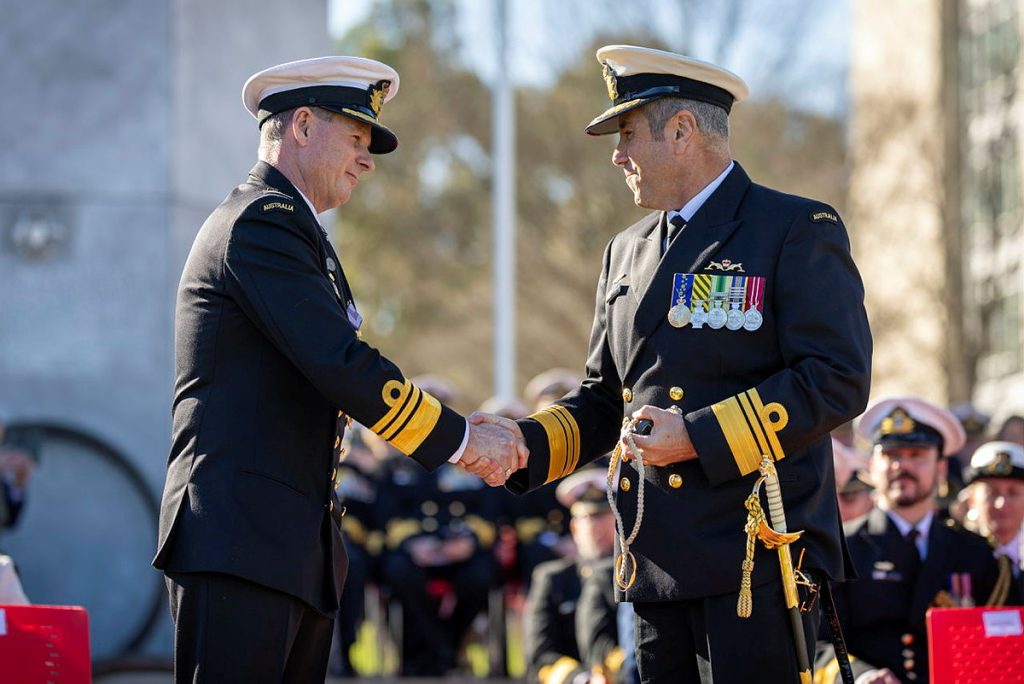
CANBERRA — The Royal Australian Navy has entered a defining new chapter, with Vice Admiral Matthew Buckley AM, CSC, RAN formally assuming command as Chief of Navy, succeeding Admiral Mark Hammond AO, RAN, who now transitions to become Australia’s new Chief of the Defence Force.
While the ceremony in Canberra on Tuesday was steeped in naval tradition, the significance extended well beyond a routine leadership change. For the first time in the Royal Australian Navy’s history, command has passed directly from one career submariner to another—an unmistakable reflection of how Australia’s strategic priorities have shifted toward undersea warfare and the AUKUS nuclear-powered submarine program.
The handover also comes at a pivotal moment for Australian defence policy. Over the coming decade the Navy must simultaneously sustain current operations while introducing nuclear-powered submarines, expanding its surface fleet, integrating autonomous systems and recruiting thousands of additional personnel. It represents arguably the largest recapitalisation of Australian naval power since Federation.
A symbolic transfer at a strategic moment
The ceremony followed centuries-old naval traditions marking the transfer of command.
After inspecting the guard, Admiral Mark Hammond AO, RAN formally relinquished command before presenting Vice Admiral Matthew Buckley AM, CSC, RAN with the symbolic “Weight” of command—the historic telescope carried by Vice Admiral Sir John Collins, Australia’s first Australian-born Chief of Naval Staff.
For the first time, a second symbolic artefact accompanied the ceremony: Admiral Hammond’s own submarine stopwatch.
The symbolism was deliberate.
In submarine operations, time governs navigation, weapons employment and survival. Combined with the Collins telescope, the two artefacts represented not simply authority, but the transfer of responsibility for Australia’s naval future.
Admiral Hammond leaves a transformed Navy
When Admiral Mark Hammond AO, RAN assumed command in 2022, Australia’s strategic outlook looked markedly different.
Russia’s invasion of Ukraine was reshaping European security, tensions across the Taiwan Strait were increasing, and Australia’s National Defence Strategy had yet to be released.
Four years later, the Navy has been fundamentally repositioned around deterrence and high-end warfighting.
During his tenure, Admiral Hammond oversaw:
- approval for the expansion of Australia’s future surface combatant fleet through the Mogami-class general-purpose frigate program;
- accelerated development of long-range maritime strike capabilities;
- introduction of uncrewed surface and underwater systems;
- establishment of the workforce foundations needed for Australia’s future conventionally armed, nuclear-powered submarines under AUKUS;
- closer integration with allied navies operating across the Indo-Pacific.
His farewell speech focused less on platforms than people.
Addressing sailors, officers and their families, Admiral Hammond described them as Australia’s “saltwater diplomats” and “seagoing deterrent force”, thanking them for quietly protecting Australia’s interests while often serving far from public attention.
He also reflected on an objective he had set upon becoming Chief of Navy.
“Put the Navy in front of the nation every single day.”
That objective drove greater public engagement through fleet reviews, major defence conferences, partnerships with sporting organisations, increased public discussion of capability development and greater visibility of naval operations.
It reflected a broader recognition that Defence must increasingly explain why Australians are investing hundreds of billions of dollars into future maritime capability.
A submariner inherits Australia’s biggest defence challenge
If Admiral Hammond’s period was about laying foundations, Vice Admiral Matthew Buckley AM, CSC, RAN now faces the task of delivering them.
A graduate of the Australian Defence Force Academy, Vice Admiral Buckley joined the Royal Australian Navy in 1990 before specialising as a submariner.
His career included service in both Oberon and Collins-class submarines, command of HMAS Collins, leadership of Australia’s submarine force, Director General Maritime Operations, Head of Nuclear Submarine Capability and, most recently, Deputy Chief of Navy.
Those appointments made him one of the architects of Australia’s emerging nuclear-powered submarine enterprise well before assuming command of the Navy itself.
A Navy unlike any before it
Vice Admiral Buckley’s first address made clear that Australia’s Navy is entering unprecedented territory.
He described the coming decade as one of “profound recapitalisation” while stressing that the Navy cannot pause current operations as new capabilities enter service.
Among the major programs now confronting the service are:
- AUKUS conventionally armed, nuclear-powered submarines;
- Hunter-class anti-submarine warfare frigates;
- Mogami-class general-purpose frigates;
- remotely operated and autonomous maritime systems;
- expanding long-range maritime strike capability;
- significant growth in both workforce and fleet size.
Each program would represent a major undertaking in isolation.
Collectively, they amount to one of the largest capability transformations attempted by the Australian Defence Force in peacetime.
The “nuclear mindset”
Perhaps the most revealing part of Vice Admiral Buckley’s speech concerned culture rather than hardware.
He repeatedly referred to developing what he called a “nuclear mindset.”
Within naval circles, that phrase carries considerable weight.
Operating nuclear-powered submarines demands uncompromising procedural discipline, engineering excellence, meticulous attention to detail and an organisational culture that tolerates virtually no avoidable error.
Vice Admiral Buckley argued those principles should extend across the entire Navy—not merely future submarine crews.
His priorities were equally clear:
- invest in highly skilled naval warfighters;
- strengthen support for sailors and their families;
- modernise current ships while introducing new capability;
- deepen partnerships across Defence, industry and allied nations;
- deliver capability “at the speed of relevance”;
- maintain safety as the overriding priority.
One phrase captured his philosophy:
“Doing it right is doing it fast.”
The challenges ahead
While the ceremony celebrated continuity, the challenges awaiting the incoming Chief of Navy are substantial.
Australia must recruit and retain thousands of additional sailors, engineers and technicians while competing for skilled workers across an already constrained labour market.
The Collins-class submarines must remain operational well into the 2030s through their life-of-type extension while the nuclear-powered submarine program develops.
New frigates must enter service without creating capability gaps.
Autonomous technologies must be integrated into existing force structures.
All of this must occur while maintaining operational commitments across an increasingly contested Indo-Pacific.
The Navy therefore faces a dual mission: prepare for tomorrow without compromising readiness today.
Why this matters
Leadership transitions within Defence often receive relatively little public attention.
This one deserves more.
Australia’s maritime strategy increasingly rests upon deterrence through advanced naval capability.
Whether that involves securing vital sea lanes, operating alongside allies, protecting critical infrastructure or contributing to regional stability, the Navy will remain central to Australia’s national security.
The officer now charged with leading that transformation is a submariner who has spent much of his career preparing for precisely this moment.
As the symbolic telescope and stopwatch changed hands, they represented more than tradition.
They marked the passing of responsibility for one of the most ambitious defence transformations in Australia’s history.
Whether the Royal Australian Navy can successfully balance today’s operational demands with tomorrow’s unprecedented capability expansion will shape Australia’s maritime security for decades to come.