
Wong Names Eight Career Officials to Key Diplomatic Posts as Canberra Refreshes Global Network
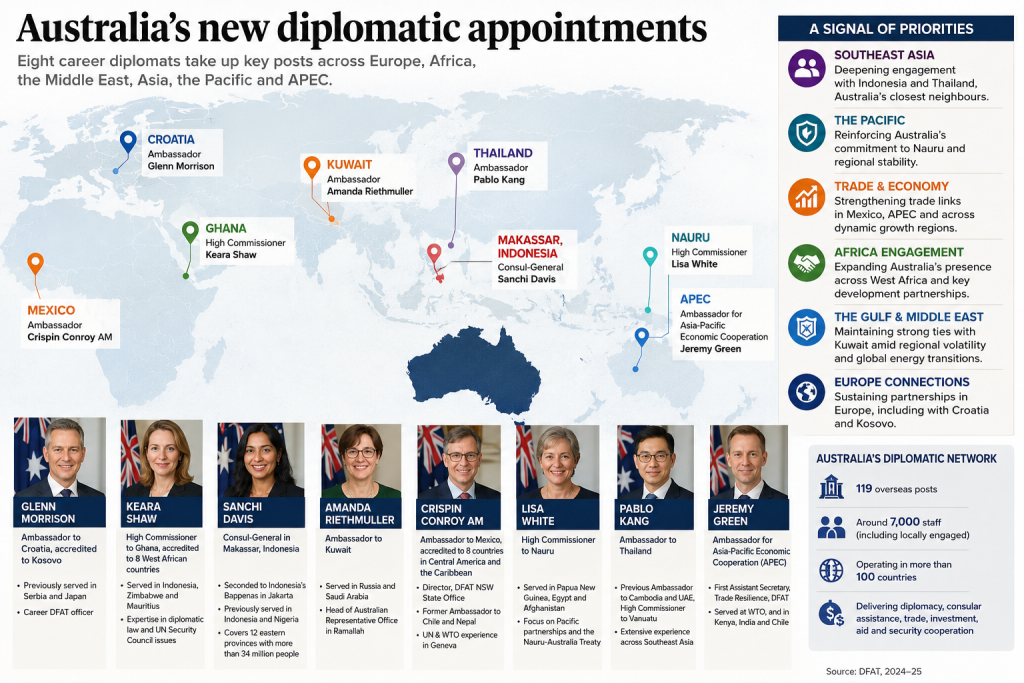
Foreign Minister Penny Wong has announced eight new senior diplomatic appointments across Europe, Africa, Southeast Asia, the Middle East, Latin America, the Pacific and APEC, in a reshuffle that quietly reveals where Canberra sees its foreign policy pressure points.
The new appointments are:
- Glenn Morrison as Ambassador to Croatia, with non-resident accreditation to Kosovo.
- Keara Shaw as High Commissioner to Ghana, with accreditation across eight additional West African countries.
- Sanchi Davis as Consul-General in Makassar, Indonesia.
- Amanda Riethmuller as Ambassador to Kuwait.
- Crispin Conroy AM as Ambassador to Mexico, also accredited to Costa Rica, Cuba, El Salvador, Guatemala, Honduras, Nicaragua, Panama and the Dominican Republic.
- Lisa White as High Commissioner to Nauru.
- Pablo Kang as Ambassador to Thailand.
- Jeremy Green as Ambassador for Asia-Pacific Economic Cooperation.
Wong described the appointees as “experienced career officials”, and that is the central point. This is not a round of political appointments. It is a professional diplomatic reshuffle, drawing on DFAT and senior public service figures rather than former ministers, party figures or public personalities.
That does not mean the appointments are unpolitical in effect. Ambassadorial appointments always signal priorities. In this case, the map points clearly to Southeast Asia, trade resilience, the Pacific, the Gulf, Africa’s resources sector, and Australia’s broader attempt to widen its diplomatic reach beyond the traditional great-power capitals.
No obvious party-political appointments
Publicly available information does not indicate that any of the eight new appointees have held elected political office or senior party roles. Searches of available public records also did not identify credible evidence of declared political campaigning or party-aligned activity by the appointees.
That matters because Australian diplomatic appointments have periodically attracted scrutiny when former politicians or political allies have been sent overseas. The Lowy Institute has previously argued that Australia lacks a single consistent and transparent procedure for appointing ambassadors, high commissioners and consuls-general, even though such appointments are among the most visible expressions of Australian foreign policy.
This round looks different. It is overwhelmingly bureaucratic, institutional and professional.
Glenn Morrison — Croatia and Kosovo
Glenn Morrison will become Australia’s next Ambassador to Croatia, with non-resident accreditation to Kosovo.
The Croatia posting is not one of Australia’s largest, but it has growing relevance. Wong’s announcement pointed to Australia’s Croatian diaspora, cultural links and a two-way trade relationship worth about $328 million in 2024, with investment of about $67 million. A new double taxation agreement is also expected to strengthen business links once in force.
Morrison is a DFAT career officer who has previously served overseas in Serbia and Japan. That background gives him useful experience in both the Balkans and North Asia, two very different diplomatic environments.
Keara Shaw — Ghana and West Africa
Keara Shaw’s appointment to Ghana is broader than the title suggests. She will also be accredited to Burkina Faso, Côte d’Ivoire, Guinea, Liberia, Mali, Senegal, Sierra Leone and Togo.
That gives the Accra post a significant regional footprint across West Africa at a time when Australia is increasingly interested in resources, agriculture, stability and development partnerships across the continent.
Shaw is a career DFAT officer who has served in Indonesia and Zimbabwe and as Acting High Commissioner to Mauritius. A 2023 Australia Africa Universities Network biography adds further detail: she served as Australia’s Chargé d’Affaires to Mauritius, Comoros, Madagascar and Seychelles from August 2022, previously worked on diplomatic law, people smuggling, UN Security Council issues, and managed security engagement with Indonesia while posted in Jakarta. Before joining DFAT, she was a lawyer and holds law and arts degrees from the University of Melbourne.
Sanchi Davis — Makassar
Sanchi Davis will become Australia’s Consul-General in Makassar, one of the more interesting appointments in the group.
Makassar matters because it is Australia’s diplomatic gateway into eastern Indonesia. DFAT says the Consulate-General covers 12 eastern provinces with a population of more than 34 million people.
The appointment also comes as Australia is trying to deepen its economic engagement with Southeast Asia. Wong noted that bilateral trade with Indonesia has almost tripled since the Indonesia-Australia Comprehensive Economic Partnership Agreement came into force in 2020.
Davis was most recently seconded to Bappenas, Indonesia’s National Development Planning Ministry, while serving at the Australian Embassy in Jakarta. She has also served in Indonesia and Nigeria.
Amanda Riethmuller — Kuwait
Amanda Riethmuller will become Ambassador to Kuwait, a Gulf posting with importance across investment, agriculture, education and regional stability.
Kuwait is described by the Foreign Minister as one of Australia’s largest sources of investment from the Middle East and a significant agricultural export market. The announcement also points to expanding education and research links, including Australian education providers operating in Kuwait and Kuwaiti students studying in Australia.
Riethmuller is a career DFAT officer with previous service in Russia and Saudi Arabia. She also served on a short-term mission as Head of the Australian Representative Office in Ramallah.
That experience suggests a diplomat with exposure to several difficult theatres: Russia, the Gulf and the Palestinian territories.
Crispin Conroy AM — Mexico and Central America
Crispin Conroy AM is the most senior and publicly documented figure in the group.
He will become Ambassador to Mexico, with accreditation extending to Costa Rica, Cuba, El Salvador, Guatemala, Honduras, Nicaragua, Panama and the Dominican Republic.
Mexico is Australia’s largest trading partner in Latin America, with total trade worth $5.8 billion in 2024–25. Australia is also chairing MIKTA in 2026, the grouping of Mexico, Indonesia, Korea, Türkiye and Australia.
Conroy was most recently Director of DFAT’s NSW State Office. DFAT records show he previously served as International Chamber of Commerce Representative Director and Permanent Observer to the United Nations in Geneva, where he led engagement with the UN system and WTO. He has also served as Ambassador to Chile, Ambassador to Nepal and Deputy High Commissioner in Papua New Guinea.
His background makes him a strong fit for a Mexico posting centred on trade, Latin America and multilateral engagement.
Lisa White — Nauru
Lisa White will become High Commissioner to Nauru, one of Australia’s most sensitive Pacific relationships.
Nauru is small, but strategically important. Wong described Australia as Nauru’s largest and most comprehensive economic, security and development partner. The relationship has also been elevated through the Nauru-Australia Treaty, which the Government says creates an integrated economic, social and security partnership.
White is a career DFAT officer who has served in Papua New Guinea, Egypt and Afghanistan.
Her appointment comes as Australia continues to compete for influence across the Pacific and seeks to lock in security and development partnerships in a region where China’s presence has become a central concern for Canberra.
Pablo Kang — Thailand
Pablo Kang’s appointment to Thailand is one of the most strategically significant in the announcement.
Thailand is Australia’s 10th largest trading partner, with two-way trade reaching $32.9 billion in 2024. The two countries signed a Strategic Partnership in 2020 and cooperate across defence, security, trade, the Mekong sub-region and regional institutions.
Kang is a senior DFAT officer with unusually broad experience. He has served as Ambassador to Cambodia, Ambassador to the United Arab Emirates and High Commissioner to Vanuatu, with earlier postings in the Philippines and the United Kingdom. In Canberra, he has headed the ASEAN-Australia Special Summit Taskforce, served as First Assistant Secretary in the Department of the Prime Minister and Cabinet’s International Division, and acted as Principal Adviser International in the Office of the Prime Minister.
Earlier this year, Wong also appointed Kang as Special Envoy on the methanol deaths in Laos, reflecting his Southeast Asia expertise.
Jeremy Green — APEC
Jeremy Green will become Ambassador for APEC, a role focused less on bilateral diplomacy and more on regional economic architecture.
APEC remains central to Australia’s regional trade agenda. Wong’s announcement states that APEC economies are home to around three billion people and account for more than 73 per cent of Australia’s total trade in goods and services.
Green is currently First Assistant Secretary, Trade Resilience, Indo-Pacific Economic and Latin America Division at DFAT. He has previously served at Australia’s Permanent Mission to the WTO and in Kenya, India and Chile.
His appointment fits the Government’s emphasis on trade resilience, open markets, digital trade, services and supply-chain security.
What the appointments say about Canberra’s priorities
Taken together, the appointments tell a clearer story than the individual announcements suggest.
Indonesia and Thailand reinforce Southeast Asia as a centre of gravity for Australian foreign policy. Nauru reflects the continuing priority given to the Pacific. Kuwait keeps Australia engaged in the Gulf at a volatile time for the Middle East. Ghana gives Australia a broader platform in West Africa. Mexico and APEC point to trade diversification and regional economic architecture. Croatia and Kosovo keep Australia engaged in Europe beyond the major EU capitals.
The striking feature is not ideological. It is technocratic.
This is a round of career officials, many with deep regional or trade expertise, being placed into posts where Canberra wants practical outcomes: trade, security, development, consular reach, investment and regional influence.
For a Government often judged by its public diplomacy on China, the United States and the Pacific, this announcement is a reminder that much of Australian foreign policy is conducted through lower-profile posts that rarely dominate headlines but shape relationships across decades.
The politics, in this case, is less about party affiliation and more about the machinery of influence: where Australia chooses to place experienced officials, what regions it wants covered, and which relationships it thinks now require deeper attention.