
Inside Canberra’s Quiet Diplomacy: How Tennis Courts, Cocktail Parties and Living Rooms Shaped a Nation
Byline: Michael Keating
⸻
The hidden architecture of Canberra’s power
At first glance, Canberra in the 1950s looked like a sparse, unfinished capital — more paddock than power centre.
Yet behind the official façades of government departments and embassies, a very different city was taking shape — one defined not by institutions alone, but by dense, informal social networks that quietly shaped Australia’s political, diplomatic and cultural trajectory.
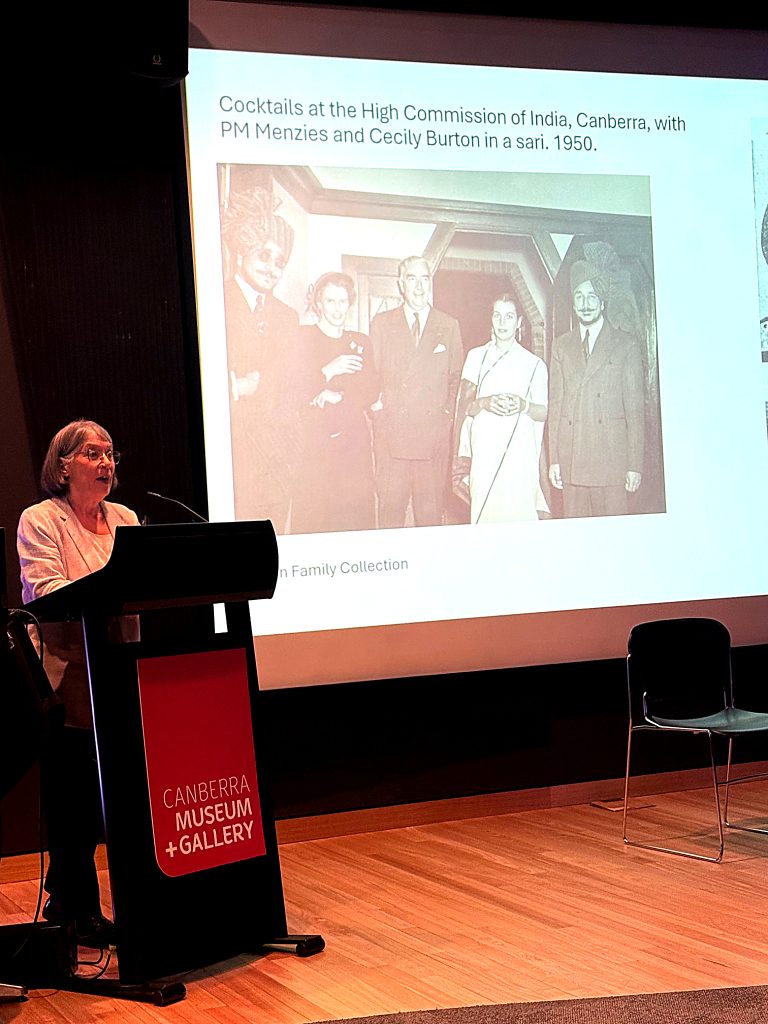
A recent talk at the Canberra Museum & Gallery as part of the National Trust ACT Heritage Festival revealed how this “social web” operated — and why it still matters today.
⸻
A city built as a social experiment
Between 1933 and 1966, Canberra’s population surged from just 8,000 to 93,000. But this wasn’t a typical Australian cross-section.
It was a curated mix:
- ambitious young public servants
- globally connected academics
- diplomats and cultural figures
- families building new lives in a national project
Canberra became, in effect, a living laboratory of nation-building — where ideas, policy, and relationships were forged simultaneously.
As outlined in the presentation, institutions like the Australian National University and the rapidly professionalising public service created a new kind of elite — not inherited, but talent-driven and networked.
⸻
The real engine: informal networks
What truly defined Canberra in this period wasn’t just Parliament or policy — it was who knew whom, and how.
Deals, ideas and influence didn’t just emerge in offices. They emerged:
- over drinks in living rooms
- at impromptu dinner parties
- in bookshops and theatres
- on cricket fields and tennis courts
As one example, economist John Crawford reportedly began diplomatic engagement with Japan not in a boardroom — but by casually returning a tennis ball over a fence.
This was quiet diplomacy in its purest form.
⸻
The tennis court as a diplomatic arena
Perhaps the most revealing insight from the talk was the role of the Canberra diplomatic tennis circuit.
Far from being just sport, tennis became:
- a neutral meeting ground
- a social equaliser (including for women)
- a hub for diplomats, academics and policymakers
From informal matches to larger social events later covered in Vogue, these gatherings blurred the lines between:
- diplomacy
- culture
- politics
Relationships built here often translated into influence elsewhere.
⸻
Cold War Canberra — intimate and immediate
The 1950s were also shaped by Cold War tensions, particularly following the Petrov Affair, which brought espionage and global politics directly into Canberra’s daily life.
Unlike larger cities, Canberra’s scale meant:
- international events felt personal
- surveillance (including ASIO monitoring) intersected with social life
- ideological divides played out at dinner tables
Historian Manning Clark’s diaries captured this vividly — recording friendships across ideological lines, alongside growing suspicion and tension.
⸻
The Burton network and the politics of proximity
Few families better illustrate this world than Cecily and John Burton, central figures in Canberra’s intellectual and diplomatic circles.
Their influence extended through:
- weekend gatherings
- bookshop salons
- theatre and cultural scenes
At times, these networks even attracted ASIO attention — highlighting how social connection itself became politically significant.
⸻
A capital defined by closeness
What made Canberra unique was not just who was here — but how closely they interacted.
Unlike today:
- people lived near each other
- social circles overlapped constantly
- children moved freely between homes
- professional and personal lives were deeply intertwined
The result was a city where:
influence flowed through proximity
and relationships often mattered as much as rank
⸻
What we’ve lost — and what remains
By the late 1960s and 1970s, Canberra began to change:
- networks became more formalised
- institutions grew more complex
- social intimacy declined
Yet the legacy remains.
Today’s “Canberra bubble” is often criticised — but historically, it was less a bubble than a highly connected ecosystem, built on shared purpose rather than isolation.
⸻
The takeaway
The talk makes a compelling case:
Canberra’s power was never just institutional.
It was social, informal, and deeply human.
Understanding that history isn’t just nostalgic — it’s instructive.
Because in a city still defined by relationships,
the quiet diplomacy continues.