
‘Build the Arch de Trump’: Hockey and Mulvaney’s Candid NPC Conversation on AUKUS, President Trump and Australia’s Strategic Future
At the National Press Club of Australia this week, former Australian Treasurer and former Ambassador to Washington Joe Hockey joined former Trump White House Chief of Staff Mick Mulvaney for one of the more revealing geopolitical conversations seen in Canberra this year.
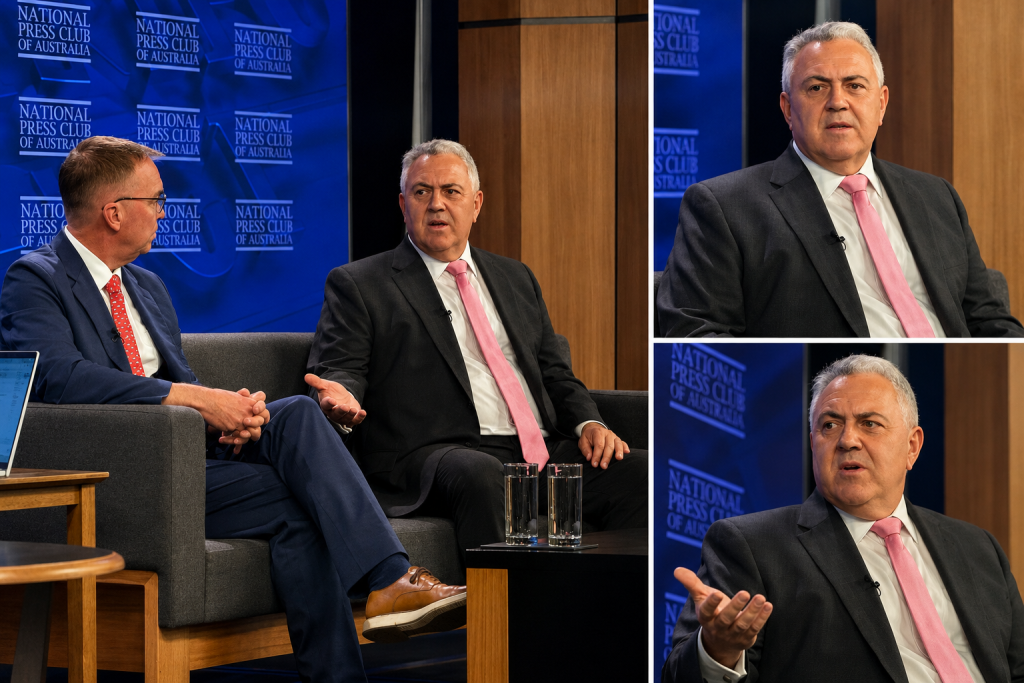
While the discussion covered everything from China to trade tensions and the future of Donald Trump’s presidency, it was the frank remarks on AUKUS, America’s submarine production problems, and one particularly amusing Canberra joke that stood out most.
The “Arch de Trump” Joke That Lit Up the Room
One of the lighter moments came when Joe Hockey reflected on the amount of construction and monument-building occurring around Washington under Donald Trump.
Hockey joked that Canberra itself may soon need an “Arch de Trump” to celebrate the scale of infrastructure and political monument-building.
The room erupted when Mulvaney quipped:
“If you named it after him, he’d pay for it.”
The exchange perfectly captured the tone of the event — informal, unusually candid, and filled with insights from two men who know Washington intimately.
It also revealed something deeper about how both men view President Trump: highly deal oriented, highly personal, and intensely conscious of legacy and symbolism.
“The Risk Has Increased”: Hockey’s Warning on Virginia-Class Submarines
But beneath the humour was a much more serious strategic warning.
Hockey delivered one of the bluntest public assessments yet of the risks facing Australia’s AUKUS submarine pathway.
He warned that the United States is struggling to manufacture Virginia-class submarines quickly enough even for its own requirements, let alone Australia’s future acquisition schedule.
“The US just has not got the production of the Virginia up to speed.”
According to Hockey, America’s industrial base faces labour shortages, procurement dysfunction and shipbuilding bottlenecks severe enough to create genuine strategic concern.
When pressed directly on whether the risks to Australia’s timeline had increased, Hockey did not hesitate.
“I think the risk has increased.”
That statement alone is likely to reverberate through defence and political circles in Canberra.
For months, the public messaging surrounding AUKUS has largely projected confidence and inevitability. Hockey’s comments instead reflected a growing recognition that the biggest challenge may not be political will — but industrial reality.
America’s Defence Production Crisis
Both Hockey and Mulvaney repeatedly returned to what they described as a broader failure of Western defence procurement systems.
Mulvaney criticised the Pentagon’s reliance on massively expensive legacy systems while modern warfare rapidly evolves around drones, AI and cheap asymmetric technologies.
“Why are we building $2 million missiles to take out $20,000 drones?”
Hockey argued Australia made similar mistakes by abandoning continuous shipbuilding capability and allowing defence procurement to become overly bureaucratic.
“We got it wrong.”
The pair suggested Australia now needs deeper integration into US defence manufacturing and greater sovereign capability if AUKUS is to remain viable over the long term.
President Trump’s America Still Runs on Relationships
Another recurring theme throughout the event was how deeply personal President Trump’s political operating style remains.
Mulvaney described President Trump as a leader who values partners who “add value” rather than simply asking for support.
“Trump is looking for partners… countries that add value.”
Hockey echoed that point repeatedly, arguing Australia should engage President Trump directly and confidently rather than treating him as a political taboo figure domestically.
The discussion also included repeated references to former Japanese Prime Minister Shinzo Abe, whom both men described as uniquely influential with President Trump.
According to Hockey, President Trump’s administration is still “missing Shinzo Abe” because few world leaders have been willing or able to build the same level of personal rapport.
Inside Canberra Analysis
The most striking aspect of the event was not the geopolitical theatre — it was the realism.
For Australia, the central message was unmistakable: AUKUS is increasingly becoming an industrial challenge rather than simply a diplomatic one.
If the United States cannot physically build submarines at the required pace, Australia’s long-term defence planning may eventually face uncomfortable decisions about capability, timelines and sovereign production.
At the same time, the conversation offered a revealing window into how President Trump’s world still functions: personal relationships matter, direct engagement matters, and countries that demonstrate practical strategic value will hold influence.
And perhaps most importantly for Canberra — if the city ever does build an “Arch de Trump,” Mulvaney may well be right about who pays for it.